


Quellenverzeichnis & Slides
- Thoughts on (Modern?) Software Development
Beobachtungen von einer 21-jährigen Reise - Solutions for (Modern?) Software Development
Annäherungen während einer 21-jährigen Reise - Thoughts to Solutions
Beobachtungen zu (moderner?) Agilität - From Education to Employment
Anforderungen an moderne Softwareentwickler:innen
„Thoughts on (Modern?) Software Development – Beobachtungen von einer 21-jährigen Reise“
Der Reisende
- https://www.linkedin.com/in/alexthurow
- https://onmoderndev.de
- https://mstdn.social/@alexthurow
- https://www.xing.com/profile/Alexander_Thurow3
[starting] Charakteristiken – Softwareentwicklung
- https://mas.to/@tastapod
- https://www.goodreads.com/book/show/13629.The_Mythical_Man_Month
- https://en.wikipedia.org/wiki/Fred_Brooks
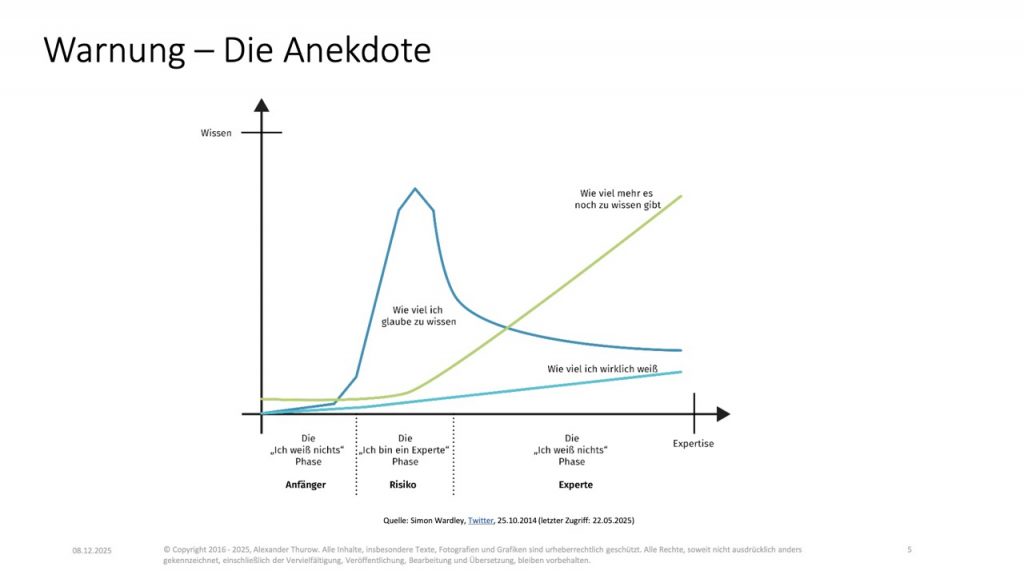
Warnung – Die Anekdote
Warnung – Die wissenschaftliche Studie
- https://en.wikipedia.org/wiki/Dunning%E2%80%93Kruger_effect
- nhttps://www.scientificamerican.com/article/the-dunning-kruger-effect-isnt-what-you-think-it-is
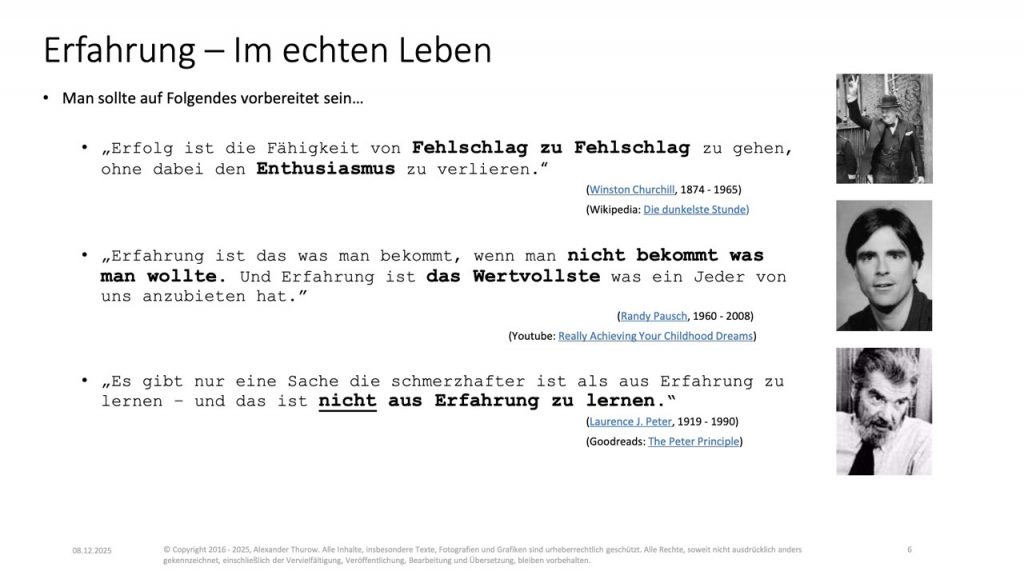
Erfahrung – Im echten Leben
- https://en.wikipedia.org/wiki/Winston_Churchill
- https://de.wikipedia.org/wiki/Die_dunkelste_Stunde
- https://de.wikipedia.org/wiki/Randy_Pausch
- https://www.youtube.com/watch?v=ji5_MqicxSo
- https://en.wikipedia.org/wiki/Laurence_J._Peter
- https://www.goodreads.com/book/show/890728.The_Peter_Principle
Auszug aus dem Vorwort von „Das Peter-Prinzip“
„[…] Death Is Nature’s Warning to Slow Down
As individuals we tend to climb to our levels of incompetence.
We behave as though up is better and more is better, and yet all around us we see the tragic victims of this mindless escalation.
We see men in groups, and most of the human race, struggling for status on a treadmill to oblivion, escalating warfare and weaponry to overkill the population of the world, escalating production of power and products while polluting the environment and upsetting the life-supporting ecological balance.
If man is going to rescue himself from a future intolerable existence, he must first see where his unmindful escalation is leading him. He must examine his objectives and see that true progress is achieved through moving forward to a better way of life, rather than upward to total life incompetence. Man must realize that improvement of the quality of experience is more important than the acquisition of useless artifacts and material possessions. He must reassess the meaning of life and decide whether he will use his intellect and technology for the preservation of the human race and the development of the humanistic characteristics of man, or whether he will continue to utilize his creative potential in escalating a super-colossal deathtrap.
Man, on occasion, has caught a glimpse of his reflection in a mirror, and not immediately recognizing himself, has begun to laugh before realizing what he was doing. It is in such moments that true progress toward understanding has occurred. This book is intended to be that mirror.
LAURENCE J. PETER
August, 1970’‘
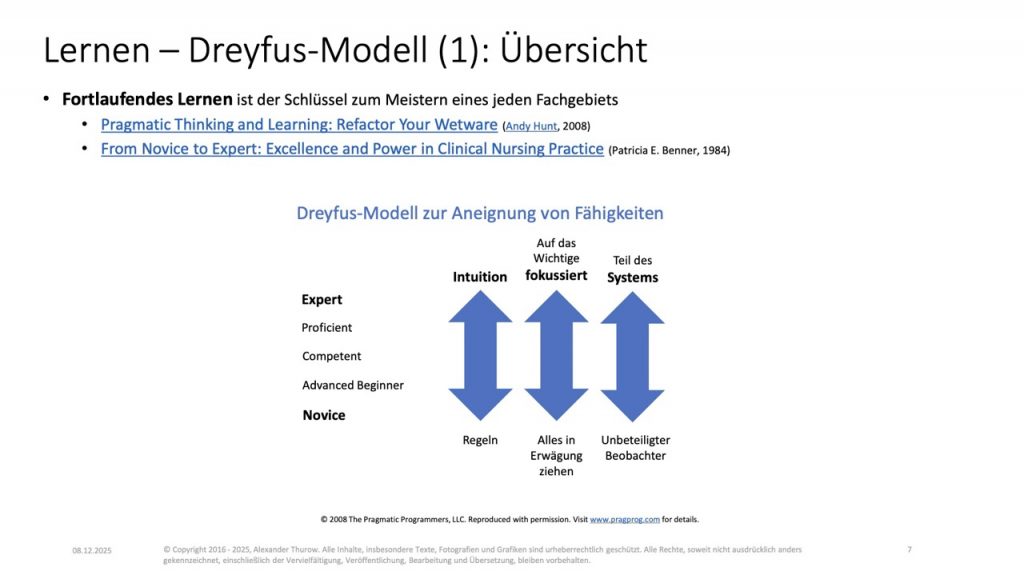
Lernen – Dreyfus-Modell (1): Übersicht
- https://www.goodreads.com/book/show/3063393-pragmatic-thinking-and-learning
- https://www.goodreads.com/book/show/1368823.From_Novice_to_Expert
- https://mastodon.social/@PragmaticAndy
- https://www.pragprog.com/
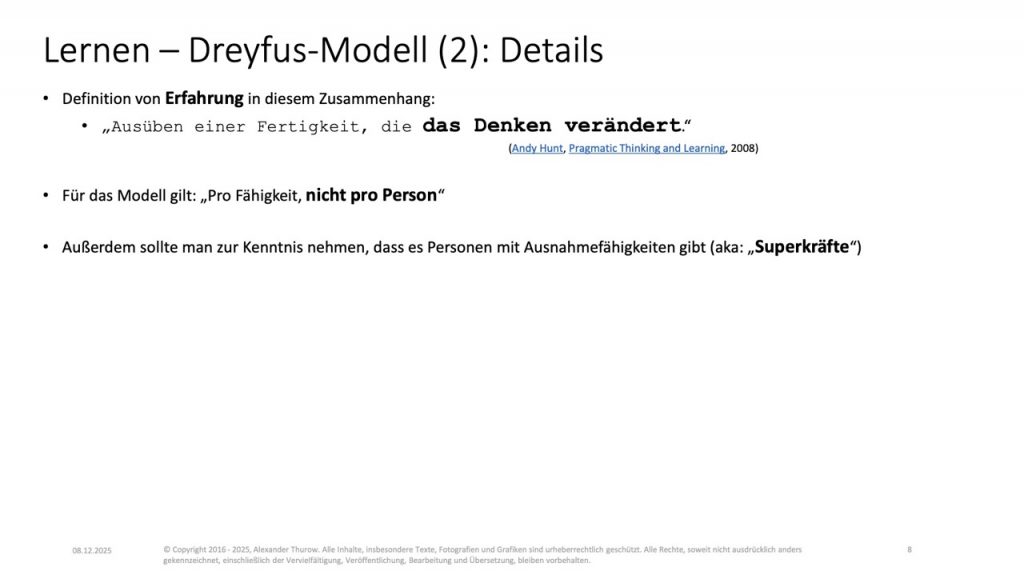
Lernen – Dreyfus-Modell (2): Details
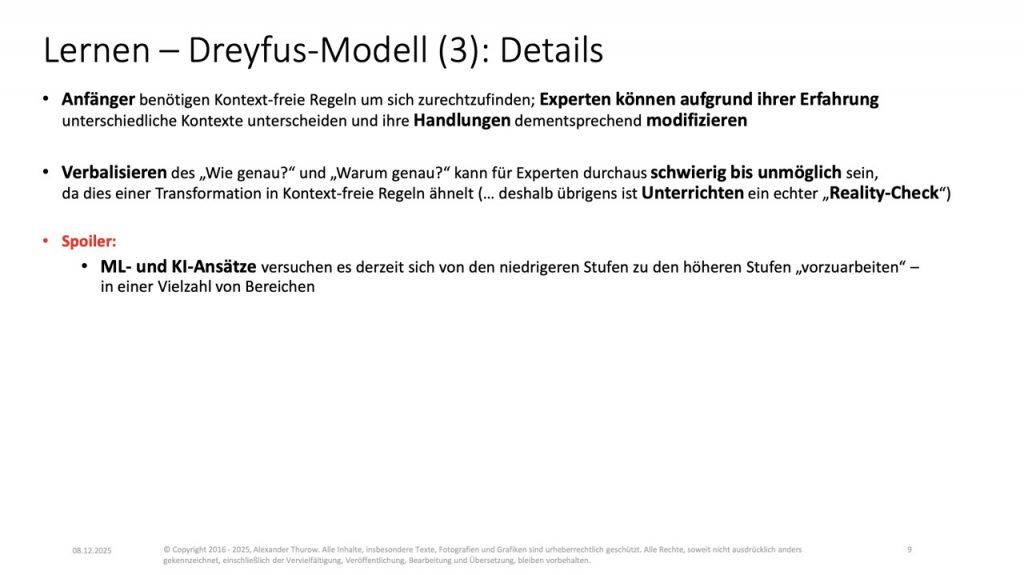
Lernen – Dreyfus-Modell (3): Details
Lernen – Dreyfus-Modell (4): Implikationen
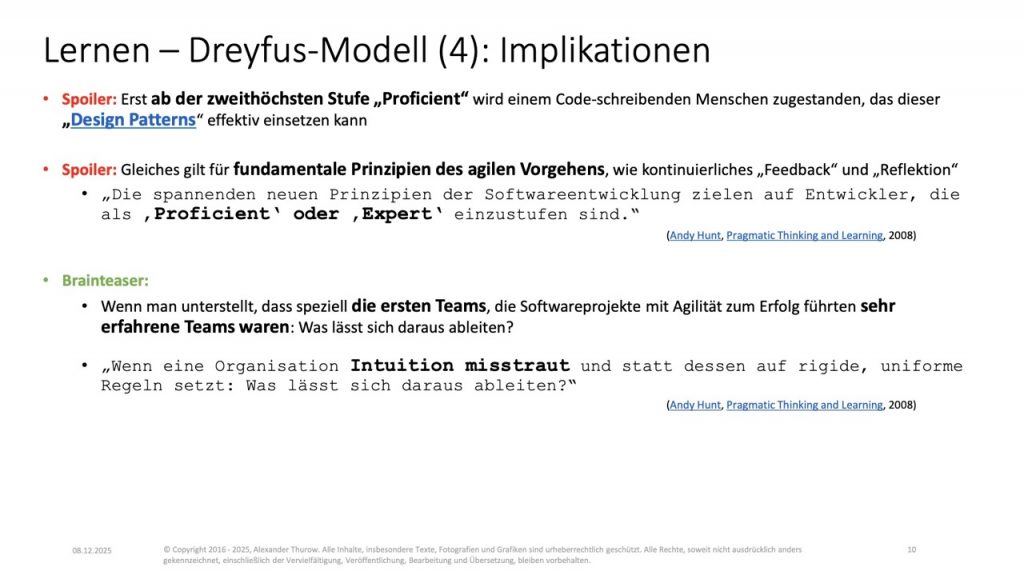
Lernen – Refactor Your Wetware
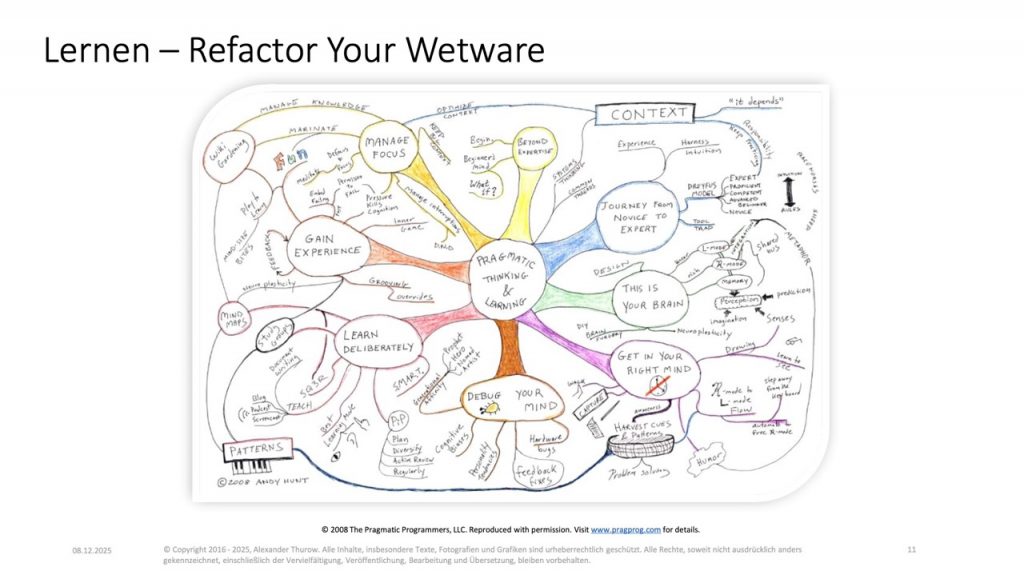
Exkurs – Cognitive Biases (1)
- https://de.wikipedia.org/wiki/Kognitive_Verzerrung
- https://de.wikipedia.org/wiki/Wahrnehmung
- https://de.wikipedia.org/wiki/Erinnerung_(Psychologie)
- https://de.wikipedia.org/wiki/Denkpsychologie
- https://de.wikipedia.org/wiki/Urteil_(Logik)
- https://de.wikipedia.org/wiki/Heuristik
- https://en.wikipedia.org/wiki/Anchoring_(cognitive_bias)
- https://en.wikipedia.org/wiki/Automation_bias
- https://en.wikipedia.org/wiki/Curse_of_knowledge
- https://upload.wikimedia.org/wikipedia/commons/6/65/Cognitive_bias_codex_en.svg
Exkurs – Cognitive Biases (2)
- https://www.youtube.com/watch?v=iH2DUGLuP0g
- https://docs.google.com/presentation/d/1nH4U-mAxMhLxB9k2RKVb5fG51Z-JBmbTV-JQGAV2Q3w/edit#slide=id.p
- https://www.meetup.com/rewe-digital-events-cologne/events/281166106
Softwareentwicklung „in der freien Wildbahn“
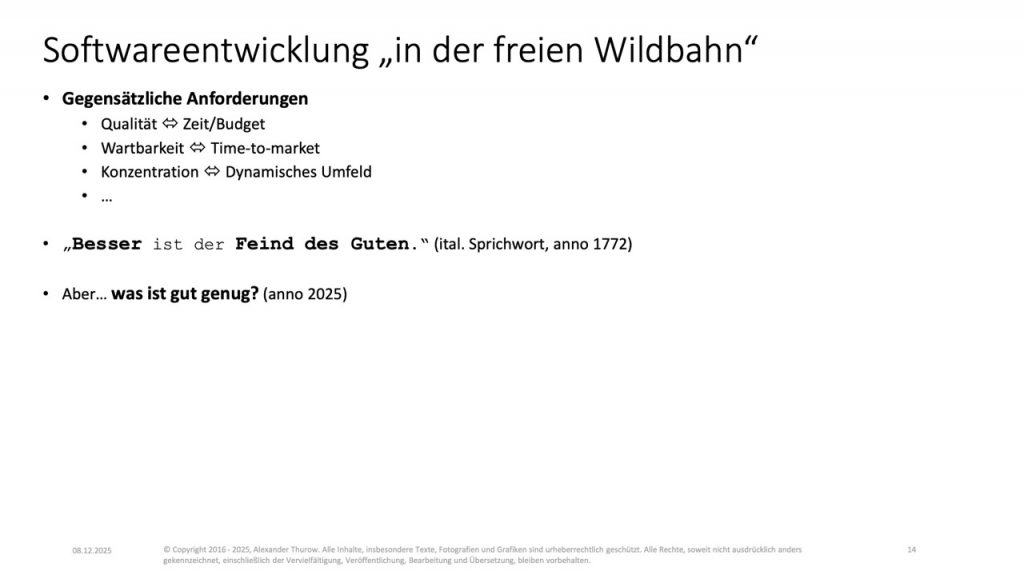
Einflussfaktoren
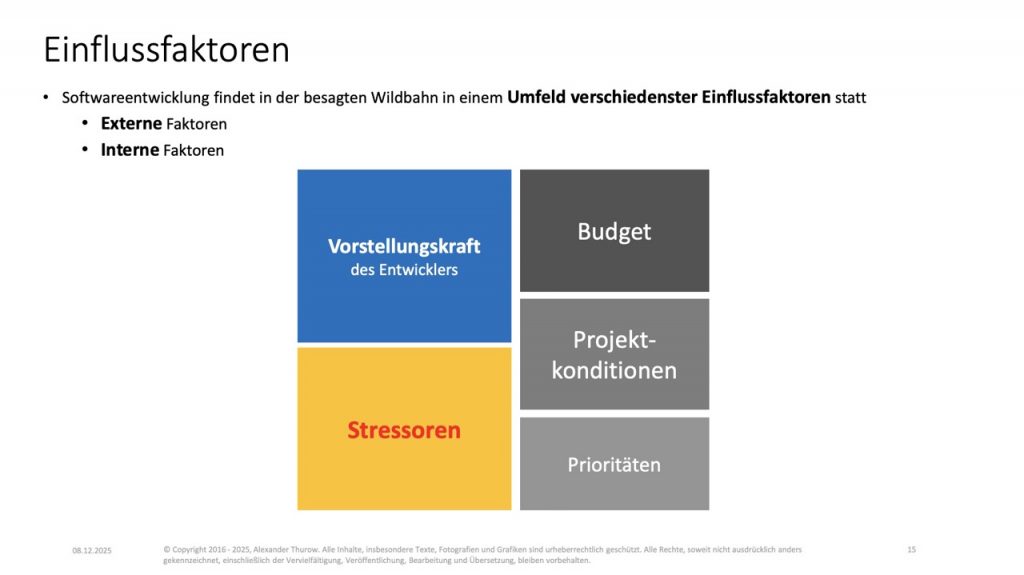
Exkurs – Vorstellungskraft?
- https://www.projectcartoon.com/ (nicht mehr online)
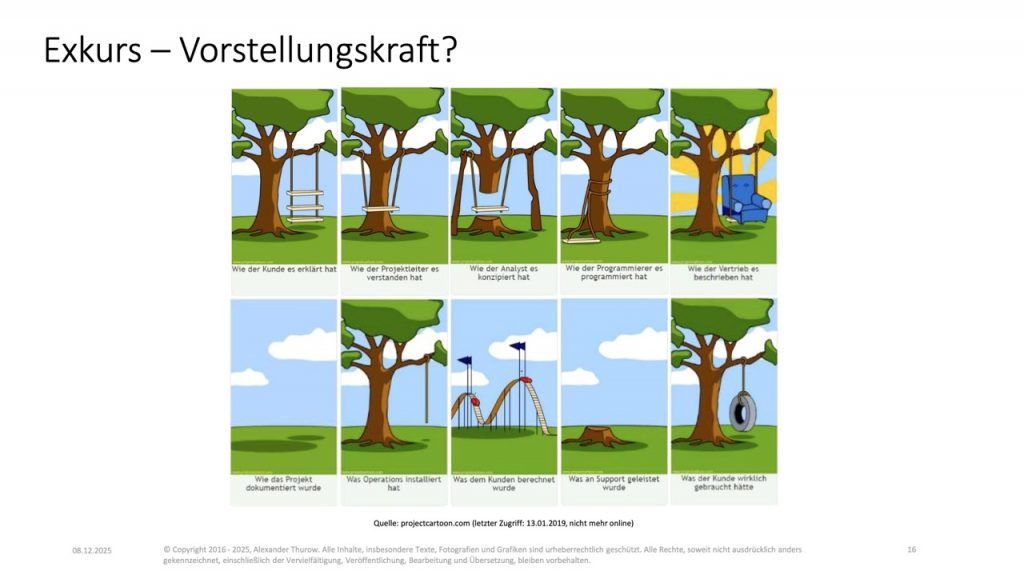
Vorstellungskraft!
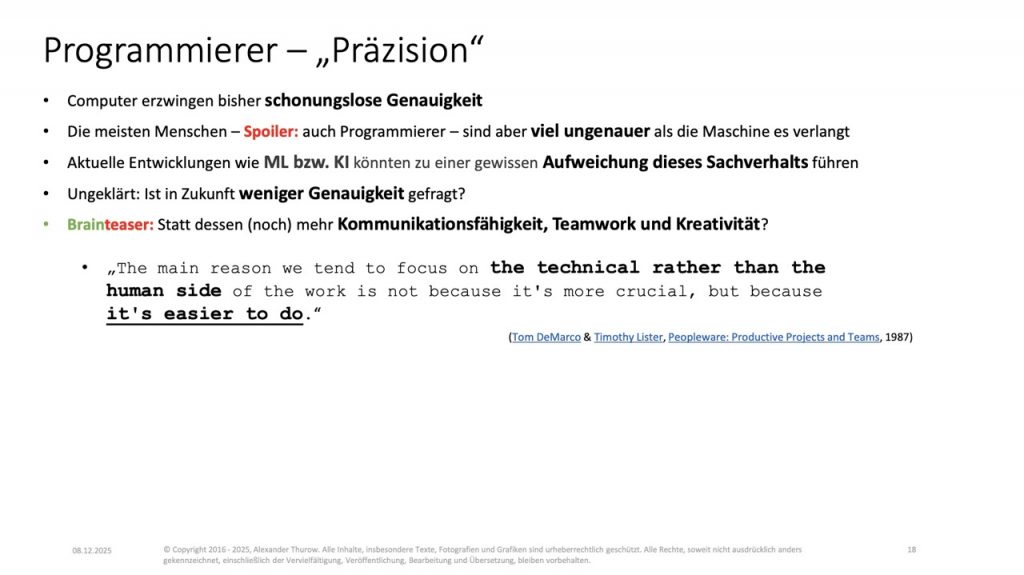
Programmierer – „Präzision“
- https://en.wikipedia.org/wiki/Tom_DeMarco
- https://en.wikipedia.org/wiki/Tim_Lister
- https://mstdn.social/@alexthurow/109246695222363813
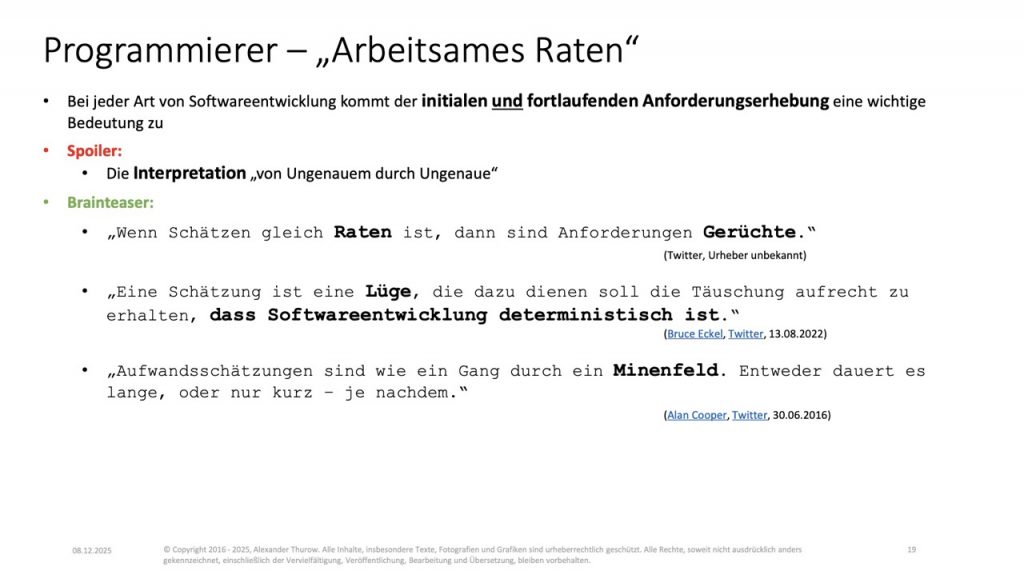
Programmierer – „Arbeitsames Raten“
- https://twitter.com/BruceEckel/status/1558496410034749441
- https://twitter.com/MrAlanCooper/status/748635043199782913
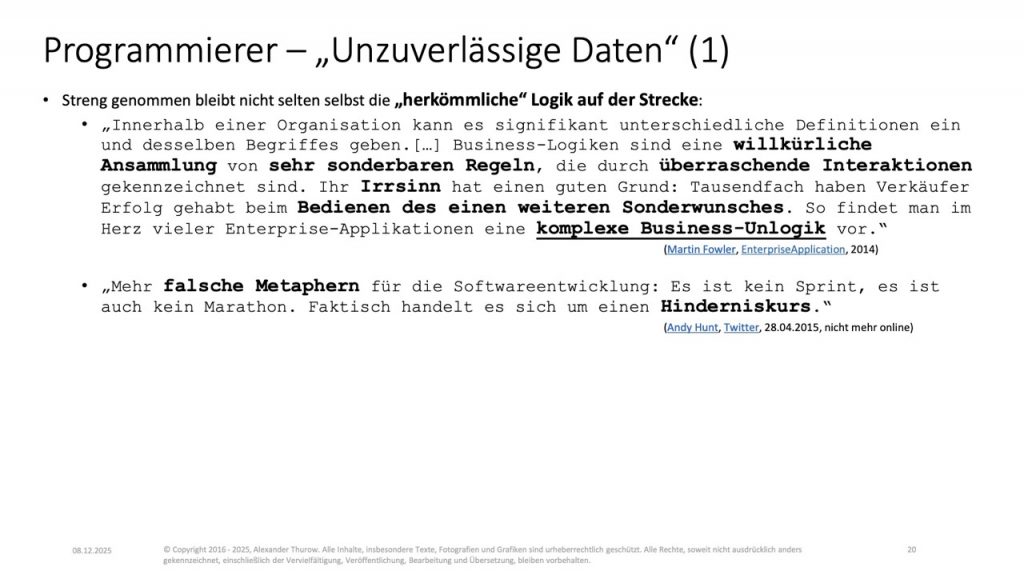
Programmierer – „Unzuverlässige Daten“ (1)
- https://toot.thoughtworks.com/@mfowler
- https://martinfowler.com/bliki/EnterpriseApplication.html
- https://twitter.com/PragmaticAndy/status/593097855520403456 (nicht mehr online)
- https://mstdn.social/@alexthurow/109370617328541302
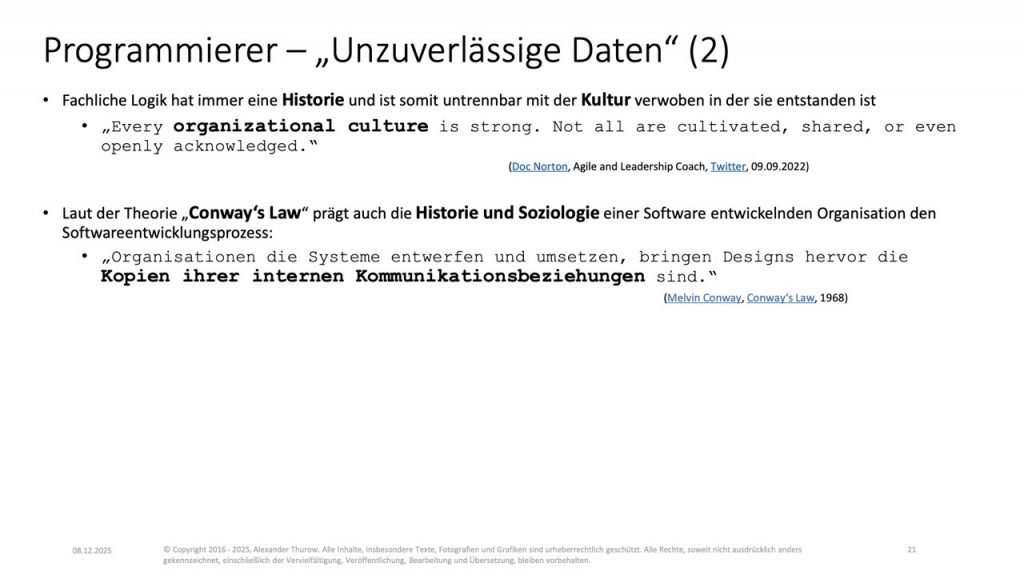
Programmierer – „Unzuverlässige Daten“ (2)
- https://docondev.com/
- https://twitter.com/DocOnDev/status/1568286111214043138 (nicht mehr online)
- https://en.wikipedia.org/wiki/Melvin_Conway
- https://en.wikipedia.org/wiki/Conway’s_law
Programmierer – „Unzuverlässige Daten“ (3)
Programmierer – „Fragwürdiges Wissen“ (1)
- https://mstdn.social/@alexthurow/109377869734939753
- https://twitter.com/ufried/status/839520650851135488
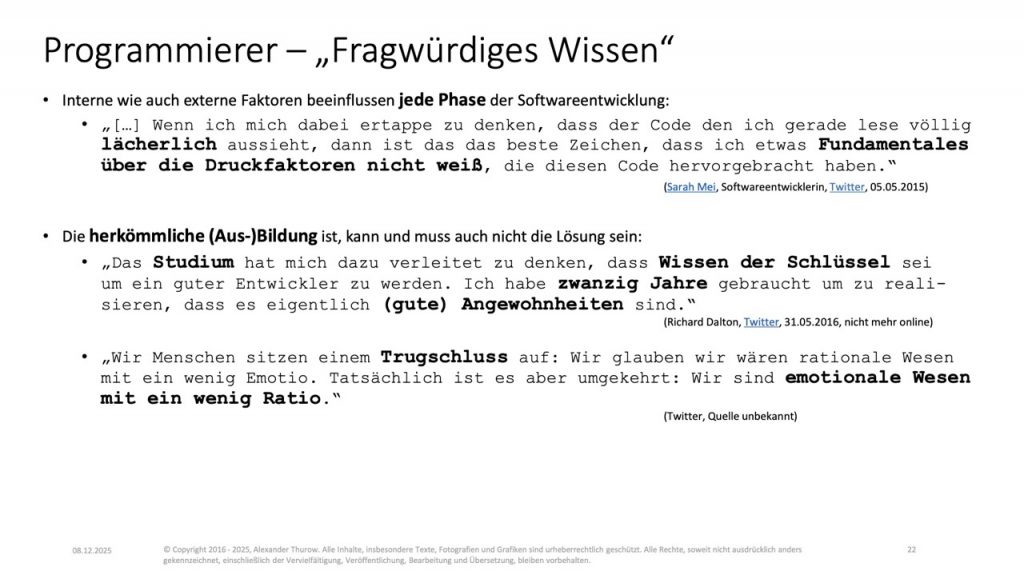
Programmierer – „Fragwürdiges Wissen“ (2)
- https://twitter.com/richardadalton/status/737705680631672832 (nicht mehr online)
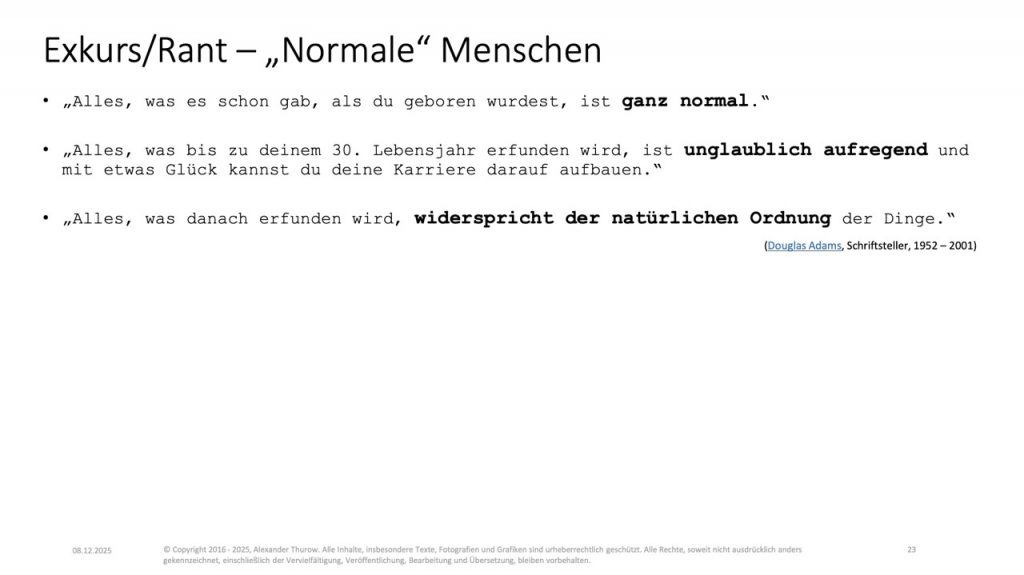
Exkurs/Rant – „Normale“ Menschen
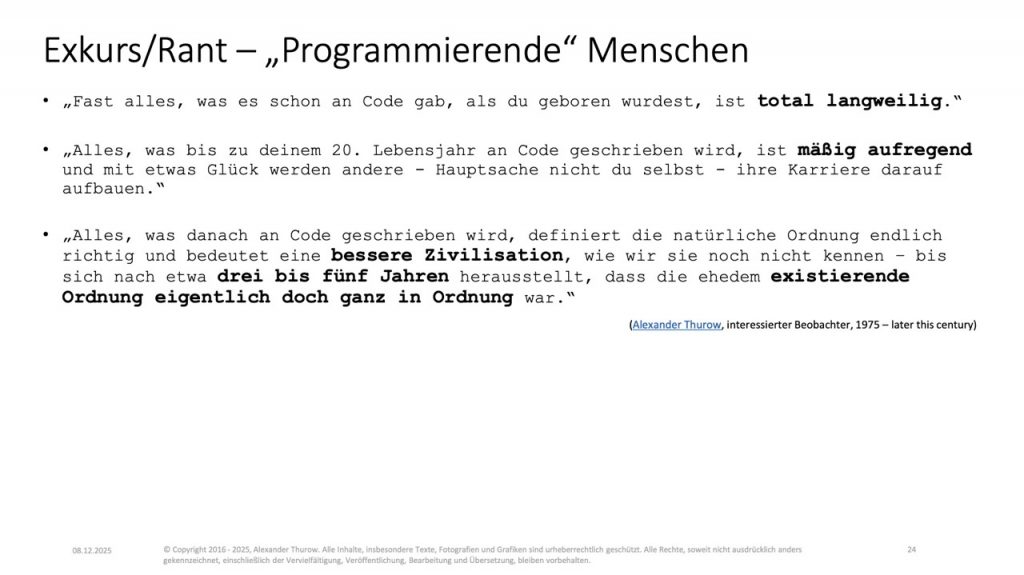
Exkurs/Rant – „Programmierende“ Menschen
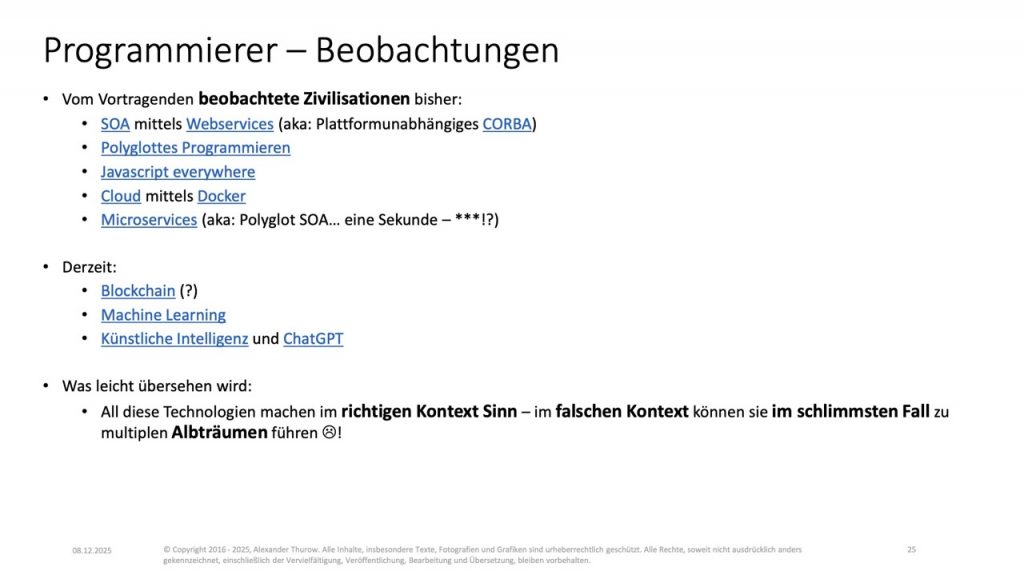
Programmierer – Beobachtungen
- https://en.wikipedia.org/wiki/Service-oriented_architecture
- https://en.wikipedia.org/wiki/Web_service
- https://en.wikipedia.org/wiki/Common_Object_Request_Broker_Architecture
- https://deanwampler.github.io/polyglotprogramming/
- https://de.slideshare.net/jbandi/there-is-something-about-javascript-choose-forum-2014
- https://en.wikipedia.org/wiki/Cloud_computing
- https://en.wikipedia.org/wiki/Docker_(software)
- https://en.wikipedia.org/wiki/Microservices
- https://en.wikipedia.org/wiki/Machine_learning
- https://en.wikipedia.org/wiki/Blockchain
- https://en.wikipedia.org/wiki/Artificial_intelligence
- https://en.wikipedia.org/wiki/ChatGPT
[continued] Charakteristiken – Softwareentwicklung (2)
Programmierer – Hype Driven Development
- https://blog.daftcode.pl/hype-driven-development-3469fc2e9b22
- https://medium.com/@marekkirejczyk
- https://www.codecentric.de/wissens-hub/fachmedien/der-mythos-der-wiederverwendung
- https://twitter.com/ufried
Derzeitiger Hype – Large Language Models (1)
- https://de.wikipedia.org/wiki/K%C3%BCnstliche_Intelligenz
- https://de.wikipedia.org/wiki/Maschinelles_Lernen
- https://de.wikipedia.org/wiki/Big_Data
- https://en.wikipedia.org/wiki/Large_language_model
- https://de.wikipedia.org/wiki/ChatGPT
- https://en.wikipedia.org/wiki/GitHub_Copilot
- https://www.heise.de/news/Microsoft-GitHub-und-OpenAI-verklagt-KI-Programmierhilfe-Copilot-kopiert-Code-7331566.html
- https://toot.cafe/@baldur
- https://mstdn.social/@alexthurow/110326358220845614
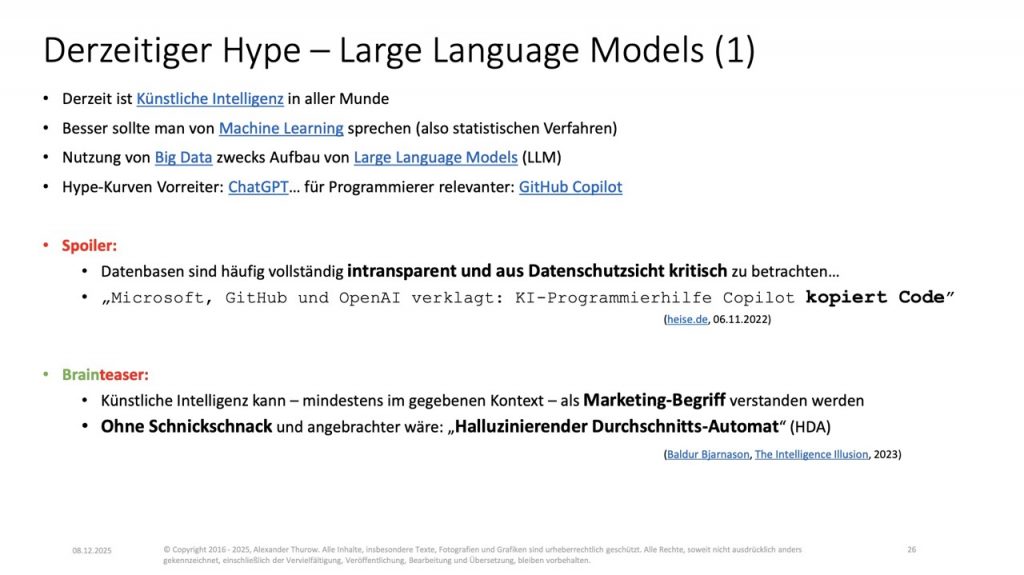
Derzeitiger Hype – Large Language Models (2)
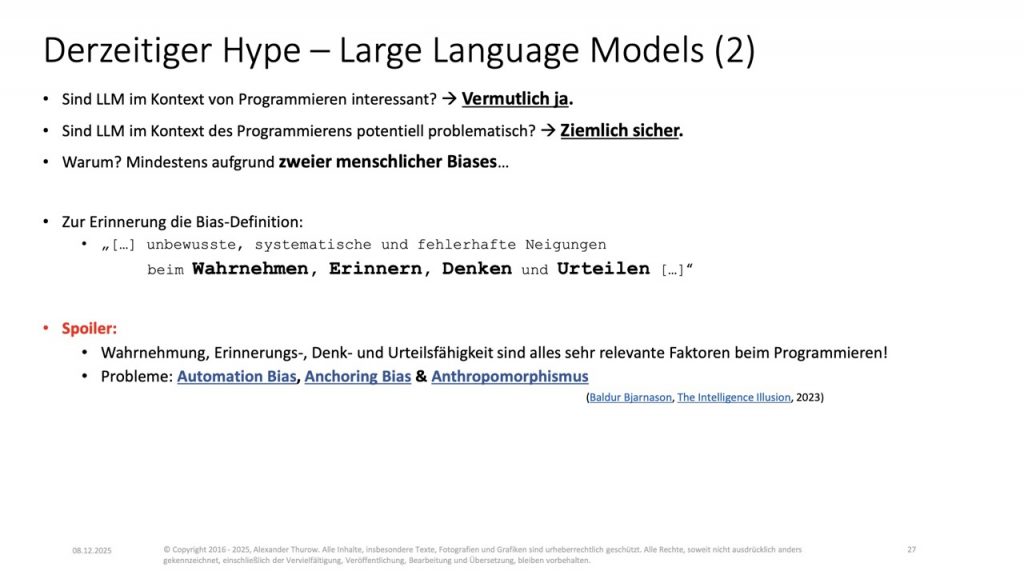
Derzeitiger Hype – Large Language Models (3)
- https://en.wikipedia.org/wiki/Casey_Newton
- https://www.platformer.news/the-ai-is-eating-itself/
- https://de.wikipedia.org/wiki/Gunter_Dueck
- https://mstdn.social/@alexthurow/109596189172698793
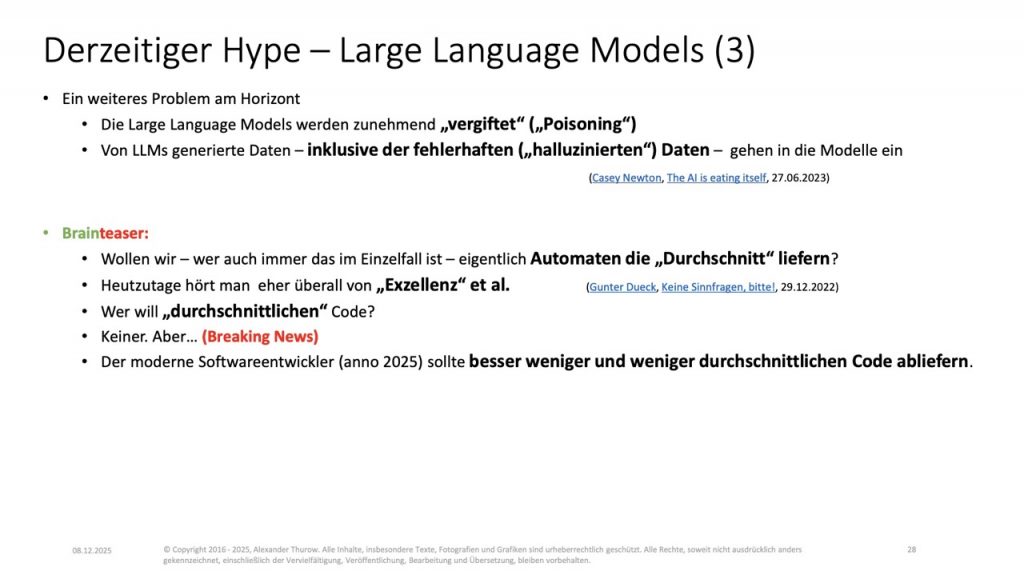
Derzeitiger Hype – Large Language Models (4)
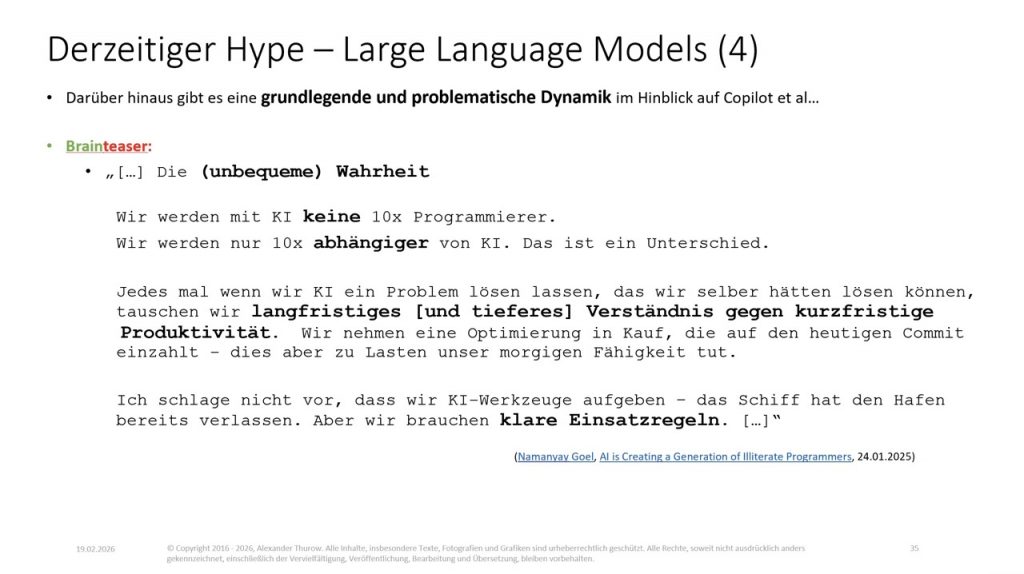
Derzeitiger Hype – Large Language Models (5)
- https://www.linkedin.com/pulse/high-time-take-chatgpt-offline-aleksandr-tiulkanov/
- https://twitter.com/shadbush
- https://mstdn.social/@alexthurow/109812349557918041
- https://twitter.com/ziobrando
- https://en.wikipedia.org/wiki/Brandolini%27s_law
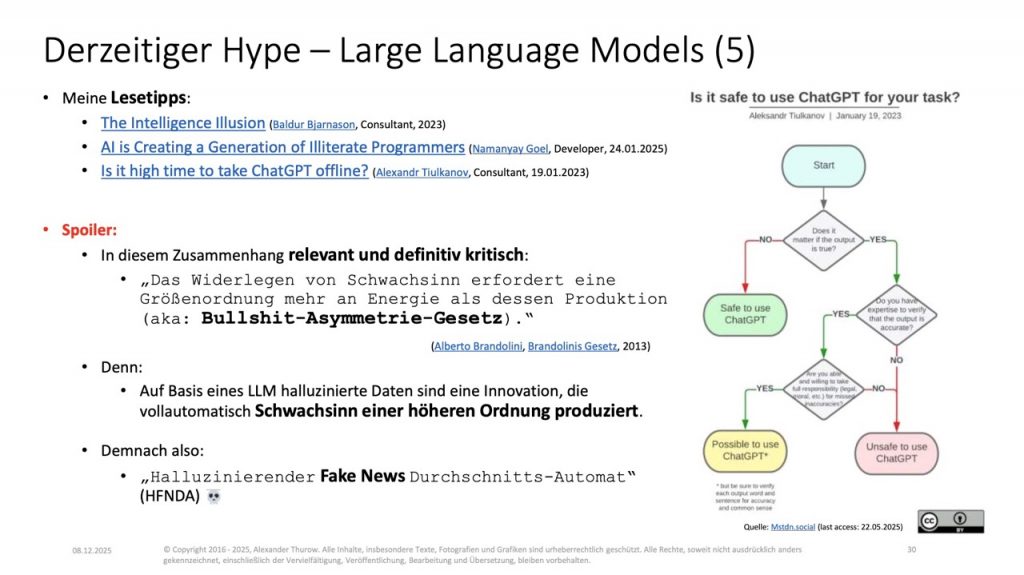
Derzeitiger Hype – Large Language Models (6)
[continued] Charakteristiken – Softwareentwicklung (3)
- https://en.wikipedia.org/wiki/Cynefin_framework
- https://en.wikipedia.org/wiki/Dave_Snowden
- https://sketchingmaniacs.com/decision-making-1
Herausforderungen (Mikro 1)
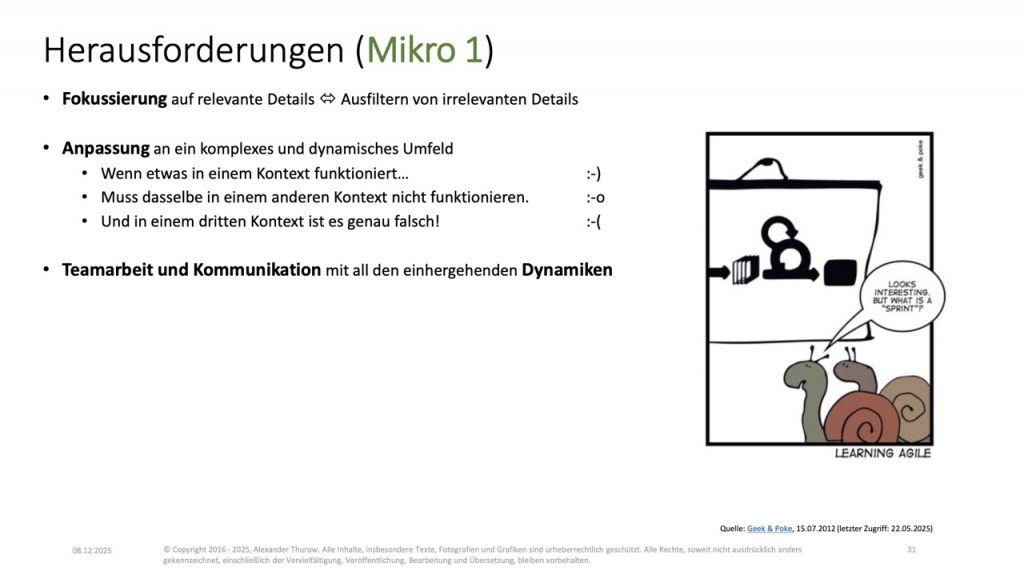
Ein Beispiel – Was ist (subjektiv) schwer?
- http://www.itworld.com/article/2833265/cloud-computing/don-t-go-into-programming-if-you-don-t-have-a-good-thesaurus.html (nicht mehr online)
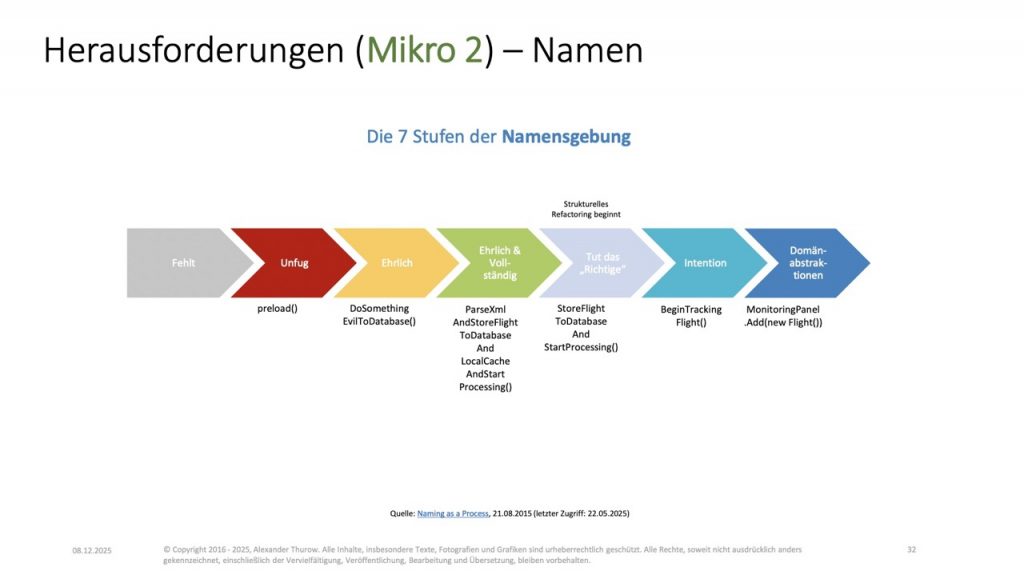
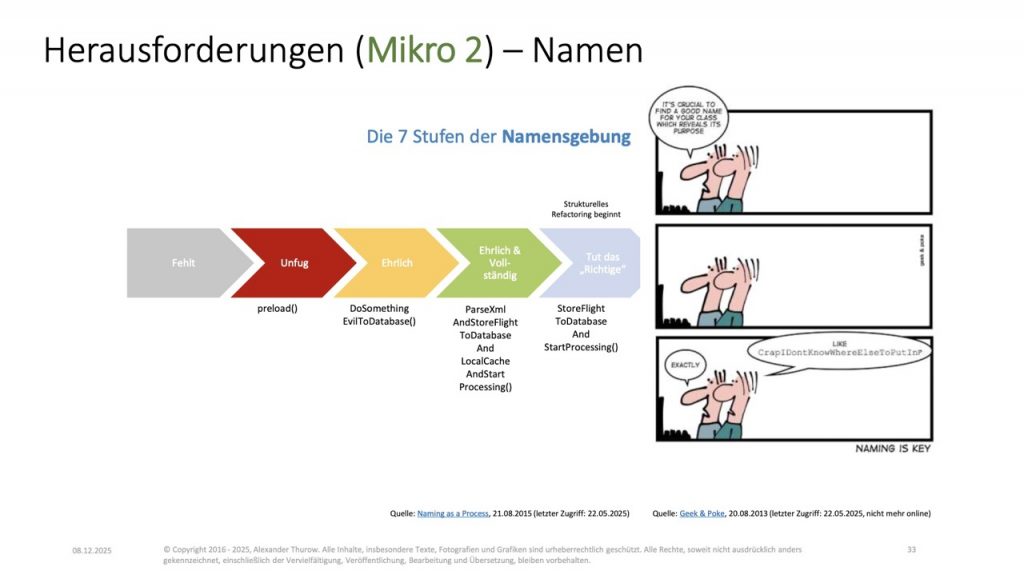
Herausforderungen (Mikro 2) – Namen
- https://www.digdeeproots.com/articles/on/naming-process/
- https://geek-and-poke.com/geekandpoke/2013/8/20/naming-is-key (nicht mehr online)
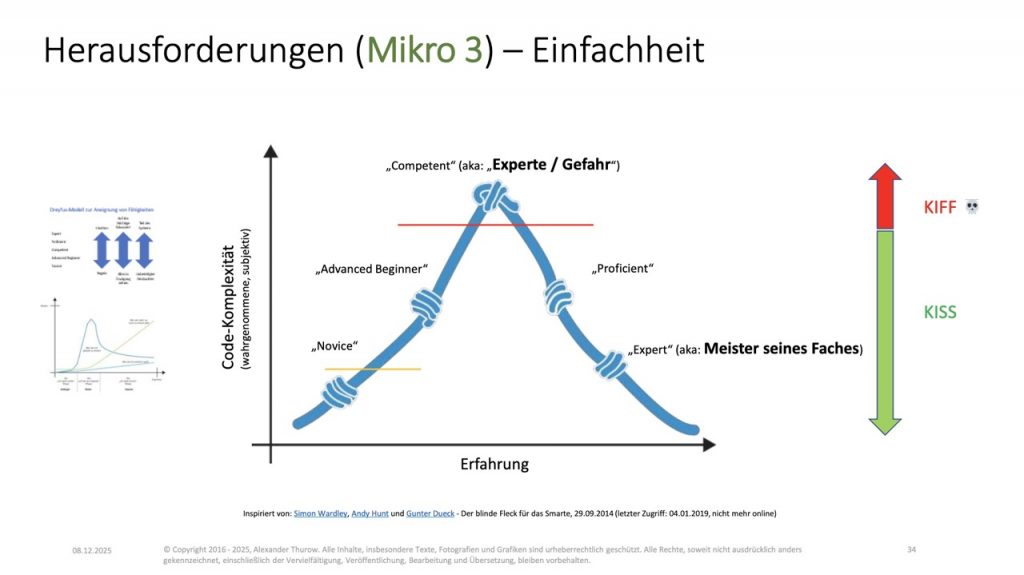
Herausforderungen (Mikro 3) – Einfachheit
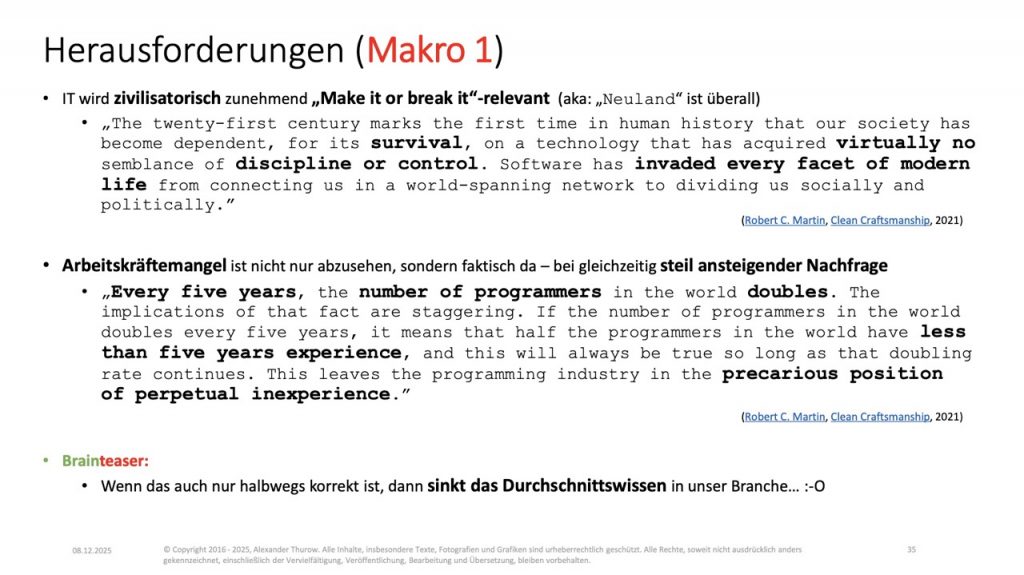
Herausforderungen (Makro 1)
- https://twitter.com/unclebobmartin
- https://www.goodreads.com/en/book/show/56631473-clean-craftsmanship
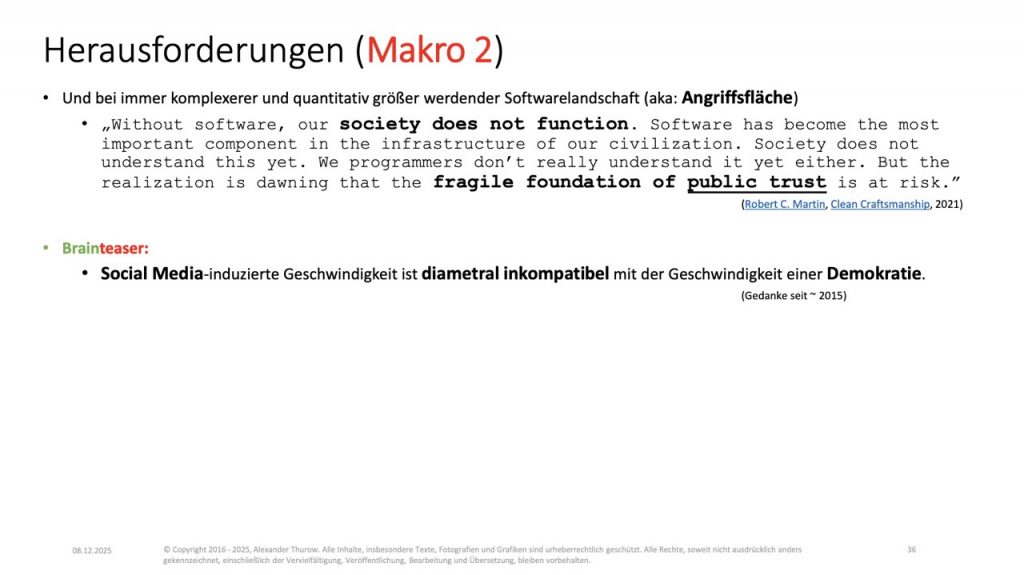
Herausforderungen (Makro 2)
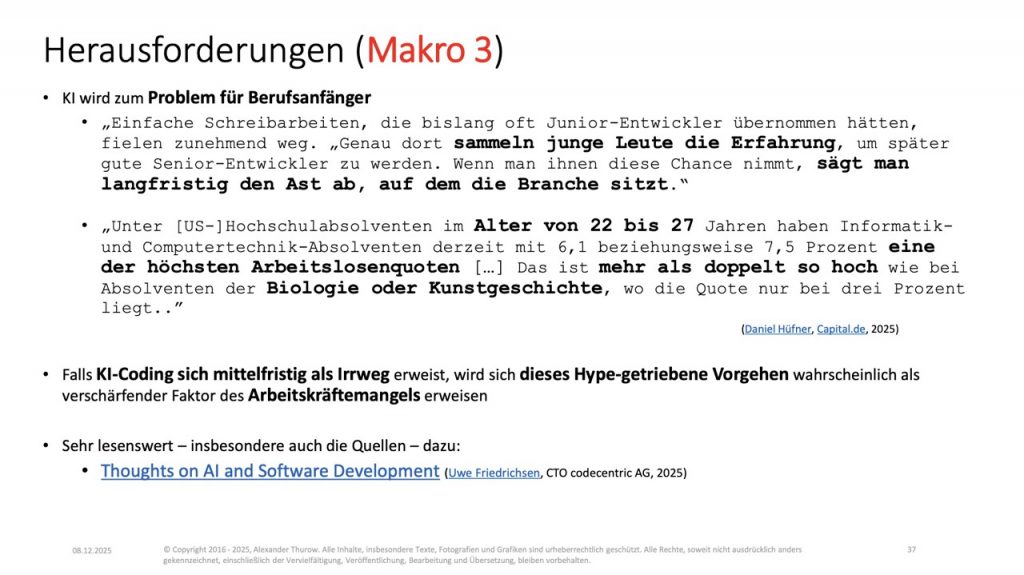
Herausforderungen (Makro 3)
- https://www.capital.de/wirtschaft-politik/ki–weniger-jobs-fuer-berufsanfaenger-durch-kuenstliche-intelligenz-35966054.html
- https://www.ufried.com/blog/ai_and_software_development_1/
Herausforderungen (Makro 4)
- https://en.wikipedia.org/wiki/Tristan_Harris
- https://www.netflix.com/de/title/81254224
- https://en.wikipedia.org/wiki/The_Social_Dilemma
- https://mstdn.social/@alexthurow/111480913665463635
Herausforderungen (Makro 5)
- https://en.wikipedia.org/wiki/Carole_Cadwalladr
- https://www.ted.com/talks/carole_cadwalladr_facebook_s_role_in_brexit_and_the_threat_to_democracy
- https://twitter.com/PhilosophyMttrs/status/1566433449455616001 (nicht mehr online)
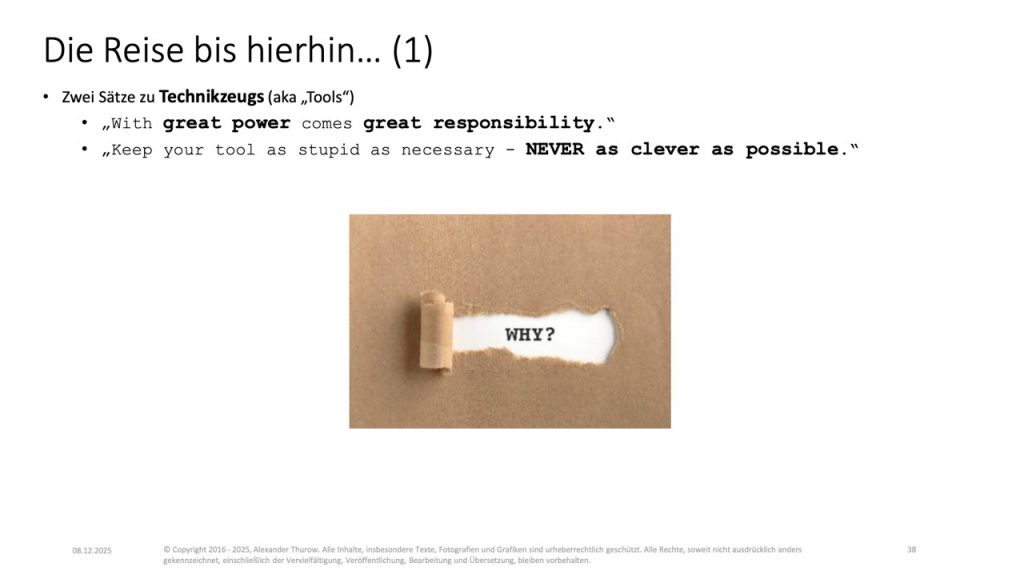
Die Reise bis hierhin… (1)
Die Reise bis hierhin… (2)
- https://twitter.com/_fletchr/status/1470483342923640834 (nicht mehr online)
- https://mstdn.social/@alexthurow/109246701228687486
- https://twitter.com/venkat_s/status/1518006880844632066
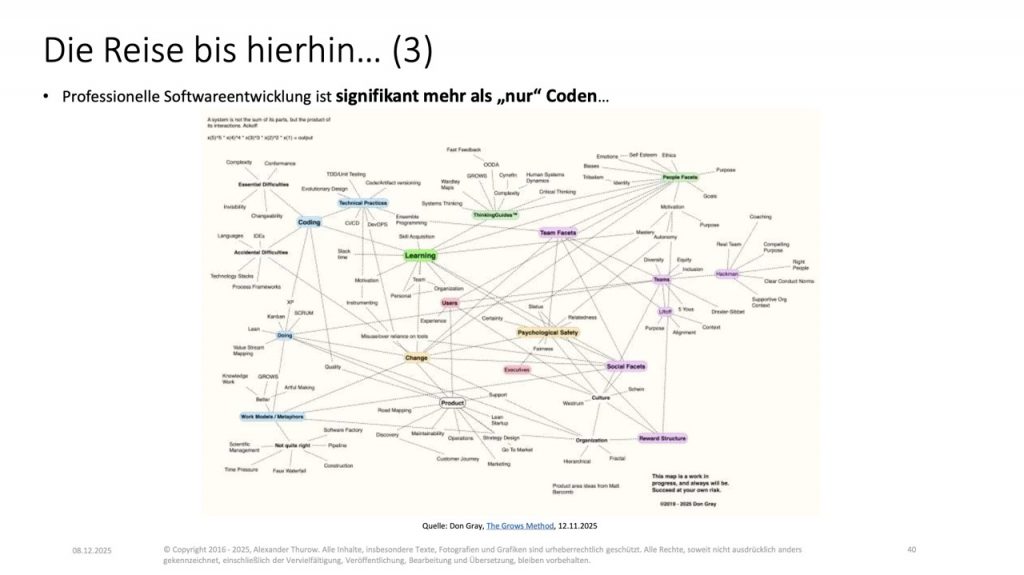
Die Reise bis hierhin… (3)
Die Reise bis hierhin… (4)
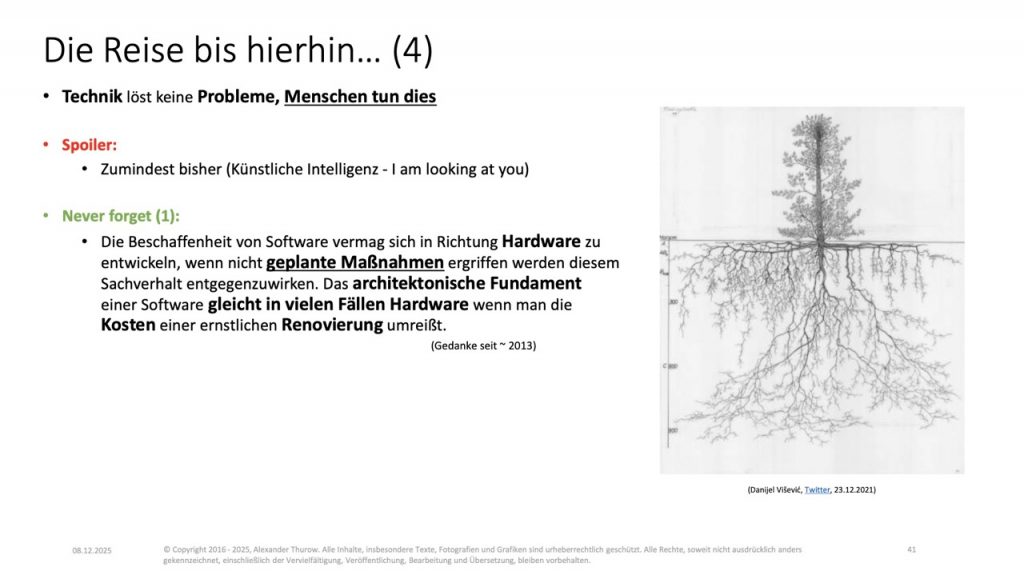
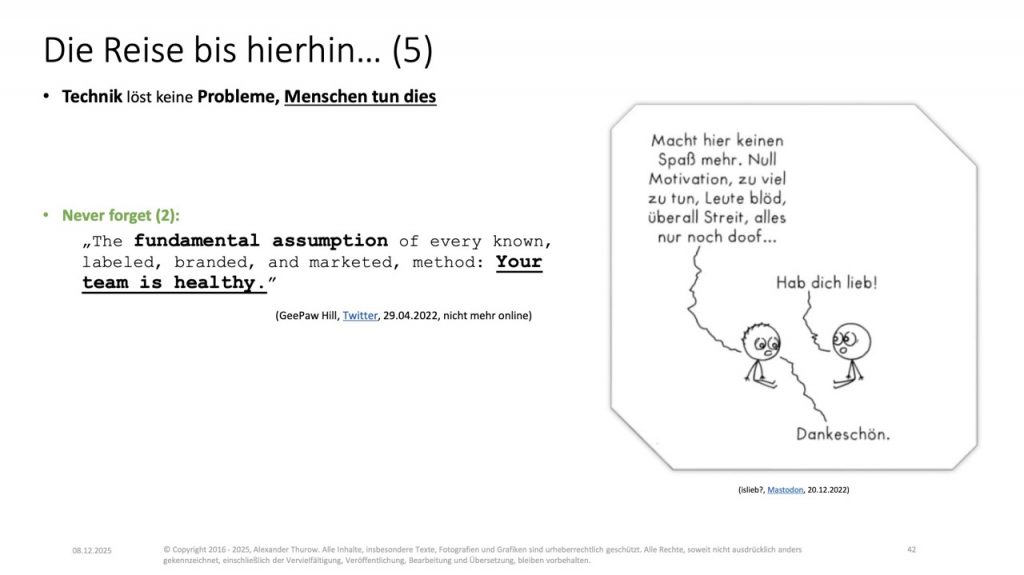
Die Reise bis hierhin… (5)
- https://twitter.com/GeePawHill/status/1519910817323528195 (nicht mehr online)
- https://mastodon.social/@islieb/109547827536520777
Die Reise geht weiter… (1)
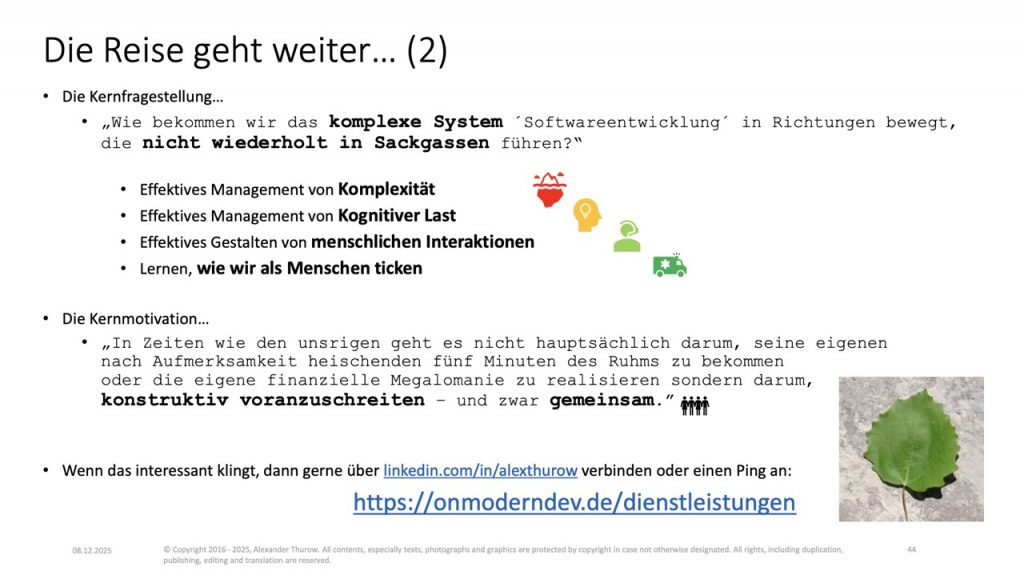
Die Reise geht weiter… (2)
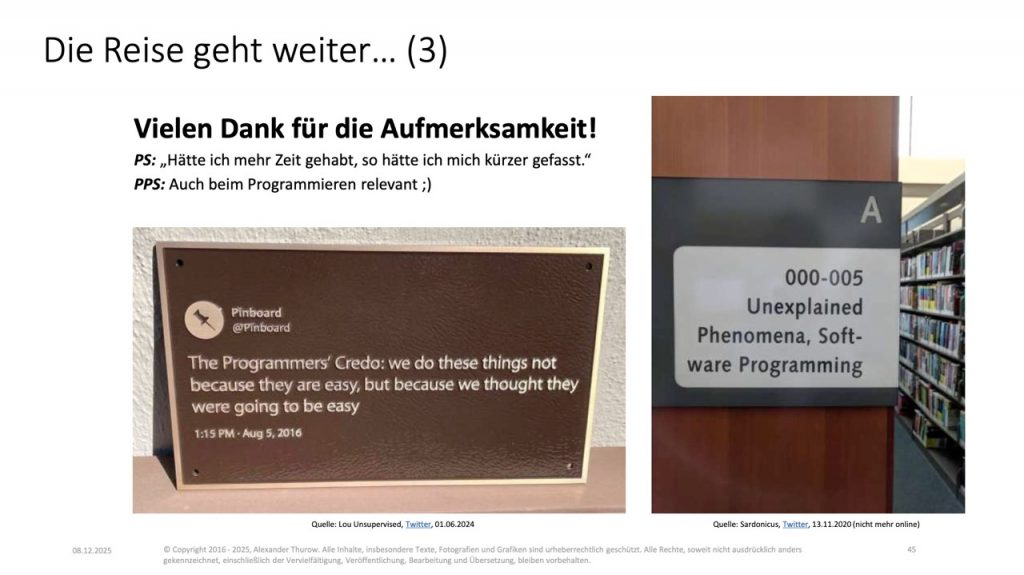
Die Reise geht weiter… (3)
- https://twitter.com/SynStalker/status/1401607925110554633
- https://twitter.com/RealSardonicus/status/1327317912873562117 (nicht mehr online)
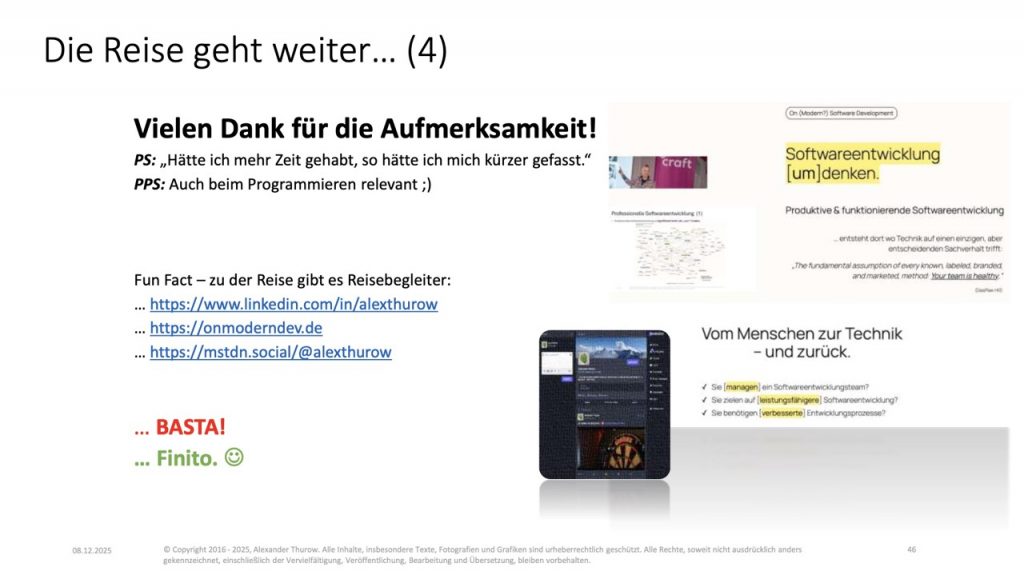
Die Reise geht weiter… (4)
- https://www.linkedin.com/in/alexthurow
- https://onmoderndev.de
- https://mstdn.social/@alexthurow
- https://onmoderndev.de/vortraege/#Solutions
Die Reise geht weiter… (5)
- https://en.wikipedia.org/wiki/David_Foster_Wallace
- https://en.wikipedia.org/wiki/This_Is_Water
- https://fs.blog/david-foster-wallace-this-is-water
Auszug aus „Dies hier ist Wasser“
„[…] Because here’s something else that’s weird but true: in the day-to-day trenches of adult life, there is actually no such thing as atheism. There is no such thing as not worshipping. Everybody worships. The only choice we get is what to worship. And the compelling reason for maybe choosing some sort of god or spiritual-type thing to worship–be it JC or Allah, be it YHWH or the Wiccan Mother Goddess, or the Four Noble Truths, or some inviolable set of ethical principles–is that pretty much anything else you worship will eat you alive. If you worship money and things, if they are where you tap real meaning in life, then you will never have enough, never feel you have enough. It’s the truth. Worship your body and beauty and sexual allure and you will always feel ugly. And when time and age start showing, you will die a million deaths before they finally grieve you. On one level, we all know this stuff already. It’s been codified as myths, proverbs, clichés, epigrams, parables; the skeleton of every great story. The whole trick is keeping the truth up front in daily consciousness.
Worship power, you will end up feeling weak and afraid, and you will need ever more power over others to numb you to your own fear. Worship your intellect, being seen as smart, you will end up feeling stupid, a fraud, always on the verge of being found out. But the insidious thing about these forms of worship is not that they’re evil or sinful, it’s that they’re unconscious. They are default settings.
They’re the kind of worship you just gradually slip into, day after day, getting more and more selective about what you see and how you measure value without ever being fully aware that that’s what you’re doing.
And the so-called real world will not discourage you from operating on your default settings, because the so-called real world of men and money and power hums merrily along in a pool of fear and anger and frustration and craving and worship of self. Our own present culture has harnessed these forces in ways that have yielded extraordinary wealth and comfort and personal freedom. The freedom all to be lords of our tiny skull-sized kingdoms, alone at the centre of all creation. This kind of freedom has much to recommend it. But of course there are all different kinds of freedom, and the kind that is most precious you will not hear much talk about much in the great outside world of wanting and achieving…. The really important kind of freedom involves attention and awareness and discipline, and being able truly to care about other people and to sacrifice for them over and over in myriad petty, unsexy ways every day.
That is real freedom. That is being educated, and understanding how to think. The alternative is unconsciousness, the default setting, the rat race, the constant gnawing sense of having had, and lost, some infinite thing.
I know that this stuff probably doesn’t sound fun and breezy or grandly inspirational the way a commencement speech is supposed to sound. What it is, as far as I can see, is the capital-T Truth, with a whole lot of rhetorical niceties stripped away. You are, of course, free to think of it whatever you wish. But please don’t just dismiss it as just some finger-wagging Dr. Laura sermon. None of this stuff is really about morality or religion or dogma or big fancy questions of life after death.
The capital-T Truth is about life BEFORE death. […]’‘
Weitere „Thoughts“-bezogene Quellen
Weitere Quellen wurden im Verlauf vieler „Thoughts on (Modern?) Software Development“-bezogenen Diskussionen genannt:
- Alex Hashtags
- Softwareentwicklungskultur
- Richard Sheridan „Joy, Inc.“
—> Wie sieht eine Firma aus, in deren DNA Kent Becks Extreme Programming eingeflochten wurde und „Freude bei der Arbeit“ groß geschrieben wird? - Tom DeMarco & Timothy Lister in „Peopleware (re-visited)“: „The High-Tech Illusion“
—> Warum glauben wir nur in der „High-Tech-Branche“ zu arbeiten, tun es aber eigentlich gar nicht? - Baldur Bjarnason: „Out of the Software Crisis“
—> Die Herausforderungen der Softwareentwicklung durch die Brille der Systemtheorie betrachtet - Gunter Duecks re:publica 2015 Vortrag über die Thematik der „Schwarmdummheit“
- Third Wave: „Wohin steuert die Tech-Branche?“
—> Sehr interessant zu lesen im Kontext von: „KI bevor KI wirklich groß wurde“ - John Allspaw: „How Your Systems Keep Running Day After Day“
—> Herausragender Talk der eine Vielzahl von Themen anspricht, z.B.: „Was passiert wenn Senior-Entwickler vor dem Team anfangen über ihr mentales Modell zu sprechen?“ - James Somers: „The Friendship That Made Google Huge“
—> Artikel über DAS zentrale Pair-Programmier-Team bei Google
- Richard Sheridan „Joy, Inc.“
- Softwareentwicklung
- Uwe Friedrichsen: „Software – It is not what you think it is – Part 1“
- Uwe Friedrichsen: „Software – It’s not what you think it is – part 6„
- Uwe Friedrichsen: „Simplify“ + „The Continuous Amnesia Issue“ + mehr
- Arlo Belshee: „Promiscuous Pairing – What Really Makes Pairing (and Mobbing) Work“
—> Ein Erfahrungsbericht zum Thema „alle zwei Stunden den Pairing-Partner wechseln“ - Dan McKinley: „Choose Boring Technology“
- Dave Thomas: „Simplicity“
- Dave Akins: „Akin’s Laws of Spacecraft Design“
- Agilität
- Kent Beck: „Extreme Programming Explained“
- Robert C. Martin in „Clean Agile“: The XP „Circle Of Life“
- Robert C. Martin: „The Future of Programming“
- Künstliche Intelligenz
- Baldur Bjarnason: „The Intelligence Illusion“
—> Warum ist KI (mindestens) potenziell „bad for your business“? - Joseph Weizenbaum: „Plug & Pray“
—> Dokumentation zu den Themen künstliche Intelligenz, Robotik und technologische Disruption. Entstanden kurz vor seinem Tod. - Uwe Friedrichsen: „Thoughts on AI and Software Development“
—> Sehr gute, vierteilige Analyse des aktuellen Stand der Dinge was „KI im Jahr 2025“ angeht - Uwe Friedrichsen: „Solving the Wrong Problem“
—> Eine Fortsetzung zum vorgenannten, vierteiligen Blogpost - Uwe Friedrichsen: „AI and the Ironies of Automation – Part 1“
—> Warum einige Überraschungen auf die Softwareindustrie warten, wenn sie KI unkritisch zur Automatisierung nutzt - Yuval Noah Harari: „Nexus“ und sein TED interview
—> Hararis Buch zum Thema KI und ein Interview das ein paar Jahre davor geführt wurde - Von Simon Wardley empfohlener Post „You Vibe It – You Run It?“
—> Zum Thema „AI ist keine Technologie, die das Lernen unterstützt“ - The Anatomy of AI: https://anatomyof.ai
—> Wie „entsteht“ KI bis sie beim „Kunden“ ankommt?
- Baldur Bjarnason: „The Intelligence Illusion“
- Technologische Disruption
- Jonathan Blow: „Preventing the Collapse of Civilization“
—> Was geschah in der Historie der Menschheit in (vermeintlich) vor-technologischen Zeiten und welche Relevanz hat das für die Softwareentwicklung? - James Somers: „The Coming Software Apocalypse“
—> Sehr schlechter „Clickbait“-Titel, großartiger Inhalt über die moderne Softwareindustrie und Softwareentwicklung im Allgemeinen - Neil Postman: Technopoly
—> Technologiekritisches Buch, das im historischen Kontext sehr interessant zu lesen ist; aus den 90er Jahren, pre-Internet, pre-Handy… - E. M. Forster: „The Machine Stops“
—> Geschrieben 1909 (!), hellsichtig wie Jules Verne mit seiner Voraussicht bzgl. U-Booten und Hochhäusern - Adam Greenfield: „Radical Technologies“ (archive.org)
—> Eine Analyse moderner disruptiver Technologien (Bitcoin, Smartphones, KI, Robotik…) + YouTube-Interview - Nicole Perlroth (NYT): „This Is How They Tell Me The World Ends“
—> Kategorie „mind-blowing“ – über das seit vielen Jahren laufende Cyberwaffen-Wettrennen - Richard Clarke’s „Cyberwar“
—> Buch aus dem Jahr 2010 vom ehemaligen Anti-Terrorismus-Zaren des Weißen Hauses, der mittlerweile in Richtung „Cyber“ abgebogen ist - Vox.com: „Flood the zone with s***: How misinformation overwhelmed our democracy“
- Jonathan Blow: „Preventing the Collapse of Civilization“
- Lernen
- Matt Beane: „The Skill Code“
—> Wie verändert sich mit KI das Lernen? - Charles Duhigg: „The Power Of Habit“
—> Wie funktionieren menschliche Gewohnheiten und wozu sind sie gut (und schlecht)? - Visualisierung zum Thema „Communication of ideas“
—> Ja, es ist wirklich so schwer… - Daniel Pink: RSA Animate: „Drive – The Surprising Truth About What Motivates Us“
- Adam Grant: „Think Again“
—> Selbstkritikfähigkeit ist eine Superkraft… wie lernt man das? - Felienne Hermans: „The Programmer’s Brain“
—> Wie funktioniert die menschliche Kognition und wie sollte man sein Gehirn „nutzen“, um es optimal einzusetzen wenn man programmiert? - Michael Lewis: „The Undoing Project“
—> Ein Portrait des Lebens von Daniel Kahneman und Amon Tversky, den „(Er)findern“ der Cognitive Biases - Nicholas Carr: „The Shallows“
—> Was passiert mit der menschlichen Kognition beim Medienwechsel Buch -> Internet? Was verändert sich dadurch?
- Matt Beane: „The Skill Code“
- Arbeitskultur und Organisationsentwicklung
- Frédéric Laloux: „Reinventing Organizations“
- Frédéric Laloux: „Reinventing Organizations visuell“
- Joana Breidenbach & Bettina Rollow: „New Work Needs Inner Work“
- Timothy R. Clark: „The 4 Stages of Psychological Safety“
- Patrick Lencioni: The Five Dysfunctions of a Team
- Donella H. Meadows: „Thinking in Systems – A Primer“
- Susan Goldsworthy: „Confronting and Navigating Inner Polarities in Leadership“
- Otto Scharmer: „u-lab: Leading From the Emerging Future“
- Spiral Dynamics: „Integrate Landkarte des IMU“
- Peter Block: „The Answer to How Is Yes“
- Ian McGilchrist: „The Master and his Emmisary“
- Business
- Evan Osnos: „Age of Ambition“
—> Ein Erfahrungsbericht über China und seine inneren Widersprüche - Maja Storch: „Das Geheimnis guter Entscheidungen“
- Ryan Holiday: „Ego is the Enemy“
- Evan Osnos: „Age of Ambition“
- Weitere Toots
- Hashtag: „AlexThuClassics“
- Michael Feathers: „Working Effectively with Legacy Code“ —> CHOOSE 2014 in der Schweiz 🙂
- „IT resiliency in one picture“
- „If your management model assumes your employees can’t be trusted, you are in big trouble. If it also assumes that the future is predictable, you are in even bigger trouble.“
- „Smart home enthusiast vs. software developer“
- Carl Sagan: Cosmos (hier starten, dann das anschauen)
„Solutions for (Modern?) Software Development – Annäherungen während einer 21-jährigen Reise“

Der Reisende
- https://www.linkedin.com/in/alexthurow
- https://onmoderndev.de
- https://mstdn.social/@alexthurow
- https://www.xing.com/profile/Alexander_Thurow3
[Recap] Charakteristiken – Softwareenwicklung
- https://mas.to/@tastapod
- https://www.goodreads.com/book/show/13629.The_Mythical_Man_Month
- https://en.wikipedia.org/wiki/Fred_Brooks
[Recap] Die Anekdote
[Recap] Einfachheit
[Recap] Professionelle Softwareentwicklung
Der Status Quo – Beobachtungen (1)
Der Status Quo – Beobachtungen (2)
Der Status Quo – Beobachtungen (3)
Der Status Quo – Beobachtungen (4)
- https://www.infoworld.com/article/3639050/complexity-is-killing-software-developers.html
- https://en.wikipedia.org/wiki/Ray_Ozzie
Der Status Quo – Beobachtungen (5)
Der Status Quo – Beobachtungen (6)
Der Status Quo – Beobachtungen (7)
Der Status Quo – Beobachtungen (8)
Der Status Quo – “Die Cloud”
Die wirkliche Herausforderung – “Die Cloud”
Hmm, Alex: Worum geht’s in der IT?
Hmm, Alex: Worum geht’s in der IT? (1)
Management von Komplexität – Die Kernfragen…
Management von Komplexität – Ein Lösungsansatz?
Management von Komplexität – Mehr Fragen…
Management von Komplexität – (d)MiB (1)
Management von Komplexität – (d)MiB (2)
Management von Komplexität – (d)MiB (3)
- https://twitter.com/sarahmei/status/595442223170256896
- https://quoteinvestigator.com/2017/05/23/culture-eats/
Management von Komplexität – (d)MiB (4)
Management von Komplexität – Prüfe Deine Metaphern (1)
- https://mstdn.social/@alexthurow/113448850224885125
- https://mstdn.social/@alexthurow/109733410356427887
- https://mstdn.social/@alexthurow/110497081496808867
Management von Komplexität – Prüfe Deine Metaphern (2)
Hmm, Alex: Worum geht’s in der IT? (2)
Management von Kognitiver Last – Das Problem (1)
Management von Kognitiver Last – Das Problem (2)
Management von Kognitiver Last – Die Umgebung (1)
Management von Kognitiver Last – Die Umgebung (2)
Management von Kognitiver Last – Optimierungen
Management von Kognitiver Last – Aufmerksamkeit (1)
- https://en.wikipedia.org/wiki/The_Magical_Number_Seven,_Plus_or_Minus_Two
- https://www.manning.com/books/the-programmers-brain
Management von Kognitiver Last – Aufmerksamkeit (2)
Management von Kognitiver Last – Ablenkungen (1)
- https://www.pearson.com/en-us/subject-catalog/p/clean-code-a-handbook-of-agile-software-craftsmanship/P200000009044/9780136083252
- https://www.goodreads.com/book/show/44919.Working_Effectively_with_Legacy_Code
Management von Kognitiver Last – Ablenkungen (2)
Management von Kognitiver Last – Ablenkungen (3)
Management von Kognitiver Last – Ablenkungen (4)
Management von Kognitiver Last – Ablenkungen (5)
Management von Kognitiver Last – Inkonsistenzen
Management von Kognitiver Last – Niemals vergessen…
- https://mstdn.social/@alexthurow/109370243005090702
- https://www.cs.utexas.edu/~EWD/transcriptions/EWD03xx/EWD340.html
- https://www.twitter.com/codeinthehole
- https://mstdn.social/@alexthurow/110204680696519678
Hmm, Alex: Worum geht’s in der IT (3)
Menschliche Interaktionen – Ernsthaft!? (1)
- https://en.wikipedia.org/wiki/Tom_DeMarco
- https://en.wikipedia.org/wiki/Tim_Lister
- https://mstdn.social/@alexthurow/109246695222363813
Menschliche Interaktionen – Ernsthaft!? (2)
Menschliche Interaktionen – Das Projekt Management Dreieck
Menschliche Interaktionen – Das Software Management Dreieck
Menschliche Interaktionen – Eine Sache namens Vertrauen…
Menschliche Interaktionen – Das Wichtigste in der IT (1)
- https://twitter.com/GeePawHill/status/1519910817323528195 (nicht mehr online)
- https://mastodon.social/@islieb/109547827536520777
Menschliche Interaktionen – Das Wichtigste in der IT (2)
Menschliche Interaktionen – Das Wichtigste in der IT (3)
Menschliche Interaktionen – Eingespielte Teams (1)
Menschliche Interaktionen – Eingespielte Teams (2)
Menschliche Interaktionen – Eingespielte Teams (3)
Menschliche Interaktionen – Eingespielte Teams (4)
Menschliche Interaktionen – Eingespielte Teams (5)
- https://www.goodreads.com/book/show/52366048-the-4-stages-of-psychological-safety
- https://www.youtube.com/watch?v=Enrosv7iLTE
Menschliche Interaktionen – Eingespielte Teams (6)
Menschliche Interaktionen – Eingespielte Teams (7)
Menschliche Interaktionen – Die lernende Organisation
- https://mstdn.social/@alexthurow/110208368636432529
- https://mstdn.social/@alexthurow/110204603652788556
- https://mstdn.social/@alexthurow/110395217231779923
Hmm, Alex: Worum geht’s in der IT? (4)
Wie Menschen ticken – Wie wir operieren…
- https://twitter.com/richardadalton/status/737705680631672832 (nicht mehr online)
Wie Menschen ticken – Refactor Your Wetware
- https://www.goodreads.com/book/show/3063393-pragmatic-thinking-and-learning
- https://mastodon.social/@PragmaticAndy
- https://www.pragprog.com/
Wie Menschen ticken – Das Dreyfus-Modell (1)
Wie Menschen ticken – Das Dreyfus-Modell (2)
Wie Menschen ticken – Das Dreyfus-Modell (3)
Wie Menschen ticken – Das Dreyfus-Modell (4)
Wie Menschen ticken – Kognitive Verzerrungen (1)
- https://de.wikipedia.org/wiki/Kognitive_Verzerrung
- https://de.wikipedia.org/wiki/Wahrnehmung
- https://de.wikipedia.org/wiki/Erinnerung_(Psychologie)
- https://de.wikipedia.org/wiki/Denkpsychologie
- https://de.wikipedia.org/wiki/Urteil_(Logik)
- https://de.wikipedia.org/wiki/Heuristik
- https://en.wikipedia.org/wiki/Anchoring_(cognitive_bias)
- https://en.wikipedia.org/wiki/Automation_bias
- https://en.wikipedia.org/wiki/Curse_of_knowledge
- https://upload.wikimedia.org/wikipedia/commons/6/65/Cognitive_bias_codex_en.svg
Wie Menschen ticken – Kognitive Verzerrungen (2)
- https://www.youtube.com/watch?v=iH2DUGLuP0g
- https://docs.google.com/presentation/d/1nH4U-mAxMhLxB9k2RKVb5fG51Z-JBmbTV-JQGAV2Q3w/edit#slide=id.p
- https://www.meetup.com/rewe-digital-events-cologne/events/281166106
Wie Menschen ticken – Sustainable pace (1)
Wie Menschen ticken – Sustainable pace (2)
Wie Menschen ticken – Sustainable pace (3)
Ok, Alex: Was ist das Ziel? (1)
Ok, Alex: Was ist das Ziel? (2)
Ok, Alex: Was ist das Ziel? (3)
Die Reise geht weiter… (1)
- https://twitter.com/SynStalker/status/1401607925110554633
- https://twitter.com/RealSardonicus/status/1327317912873562117
Die Reise geht weiter… (2)
- https://en.wikipedia.org/wiki/David_Foster_Wallace
- https://en.wikipedia.org/wiki/This_Is_Water
- https://fs.blog/david-foster-wallace-this-is-water
Die Reise geht weiter… (3)
„Thoughts to Solutions – Beobachtungen zu (moderner?) Agilität“
Der Reisende
- https://www.linkedin.com/in/alexthurow
- https://onmoderndev.de
- https://mstdn.social/@alexthurow
- https://www.xing.com/profile/Alexander_Thurow3
Professionelle Softwareentwicklung (1)
Professionelle Softwareentwicklung (2)
- https://en.wikipedia.org/wiki/Cynefin_framework
- https://en.wikipedia.org/wiki/Dave_Snowden
- https://sketchingmaniacs.com/decision-making-1
Agile Softwareentwicklung (1)
- https://www.pragprog.com
- https://de.wikipedia.org/wiki/Gunter_Dueck
- https://www.youtube.com/watch?v=uO8nEd4CY2s&list=PLPcpEUTAU3-jwT26k0YK2kqJjldnL3GTp&index=5
Agile Softwareentwicklung (2)
Professionelle Arbeits-Modi
Professionelle Meetings-Modi
Solutions for (Modern?) Software Development (1)
Solutions for (Modern?) Software Development (2)
„From Education to Employment – Anforderungen an moderne Softwareentwickler:innen“
Der Reisende
- https://www.linkedin.com/in/alexthurow
- https://onmoderndev.de
- https://mstdn.social/@alexthurow
- https://www.xing.com/profile/Alexander_Thurow3
Agenda – Übersicht
Agenda – Die Umgebung
Die Umgebung – Wohin geht es?
Die Umgebung – Einflussfaktoren
Die Umgebung – Vorstellungskraft?
Die Umgebung – Vorstellungskraft!
Die Umgebung – Herausforderungen
Agenda – Die Werkzeuge
Die Werkzeuge – Lernen
- https://www.pearson.de/clean-coder-the-a-code-of-conduct-for-professional-programmers-9780137081073
- https://en.wikipedia.org/wiki/Robert_C._Martin
- https://www.oreilly.com/library/view/the-software-craftsman/9780134052625/
- https://www.codurance.com/publications/author/sandro-mancuso
Die Werkzeuge – Lernen: Das Dreyfus-Modell
- https://pragprog.com/titles/ahptl/pragmatic-thinking-and-learning/
- https://www.goodreads.com/book/show/1368823.From_Novice_to_Expert
- https://mastodon.social/@PragmaticAndy
- https://www.pragprog.com/
Die Werkzeuge – Refactor Your Wetware
Die Werkzeuge – Erfahrung aus 10.000 Metern…
Die Werkzeuge – Erfahrung im wahren Leben…
- https://en.wikipedia.org/wiki/Winston_Churchill
- https://de.wikipedia.org/wiki/Die_dunkelste_Stunde
- https://de.wikipedia.org/wiki/Randy_Pausch
- https://www.youtube.com/watch?v=ji5_MqicxSo
- https://en.wikipedia.org/wiki/Laurence_J._Peter
- https://www.goodreads.com/book/show/890728.The_Peter_Principle
Exkurs – Die Anekdote
Exkurs – Die wissenschaftliche Studie
- https://en.wikipedia.org/wiki/Dunning%E2%80%93Kruger_effect
- https://www.scientificamerican.com/article/the-dunning-kruger-effect-isnt-what-you-think-it-is
Die Werkzeuge – Euer Kopf
Agenda – Das Coding
Das Coding – Charakteristiken von Softwareentwicklung
- https://mas.to/@tastapod
- https://www.goodreads.com/book/show/13629.The_Mythical_Man_Month
- https://en.wikipedia.org/wiki/Fred_Brooks
Das Coding – Charakteristiken von Softwareprojekten
Das Coding – Einfachheit (1)
Das Coding – Einfachheit (2)
- https://pragprog.com/titles/tpp20/the-pragmatic-programmer-20th-anniversary-edition/
- https://de.wikipedia.org/wiki/Dave_Thomas_(Programmierer)
- https://de.wikipedia.org/wiki/KISS-Prinzip
- https://de.wikipedia.org/wiki/YAGNI
- https://de.wikipedia.org/wiki/Don’t_repeat_yourself
- https://en.wikipedia.org/wiki/SOLID_(object-oriented_design)
- https://dannorth.net/blog/cupid-for-joyful-coding/
Das Coding – Einfachheit (3)
Das Coding – Einfachheit (4)
Das Coding – Technische Schulden
- https://martinfowler.com/bliki/TechnicalDebt.html
- https://en.wikipedia.org/wiki/Ward_Cunningham
- https://pkruchten.files.wordpress.com/2012/07/kruchten-110707-what-colours-is-your-backlog-2up.pdf
Das Coding – Automatisiertes Testen
- http://www.growing-object-oriented-software.com/
- http://www.growing-object-oriented-software.com/authors.html
Das Coding – Refactoring
- https://archive.org/details/working-effectively-with-legacy-code
- https://www.r7krecon.com/michael-feathers-bio
- https://geek-and-poke.com/geekandpoke/2013/8/26/refactoring-is-key (nicht mehr online)
Das Coding – Was ist (subjektiv) schwer?
- https://www.itworld.com/article/2833265/cloud-computing/don-t-go-into-programming-if-you-don-t-have-a-good-thesaurus.html (nicht mehr online)
Das Coding – Namen
- https://www.digdeeproots.com/articles/on/naming-process/
- https://geek-and-poke.com/geekandpoke/2013/8/20/naming-is-key (nicht mehr online)
Agenda – Das Fazit
Das Fazit – Takeaways
- https://archive.org/details/code-craft-the-practice-of-writing-excellent-code-2006
- https://www.goodliffe.net/
Die Reise geht weiter… (1)
- https://twitter.com/SynStalker/status/1401607925110554633
- https://twitter.com/RealSardonicus/status/1327317912873562117
Die Reise geht weiter… (2)
- https://en.wikipedia.org/wiki/David_Foster_Wallace
- https://en.wikipedia.org/wiki/This_Is_Water
- https://fs.blog/david-foster-wallace-this-is-water
Die Reise geht weiter… (3)