


Consulting
How much time can you spare [today] for the [future] of your professional [software development culture]?
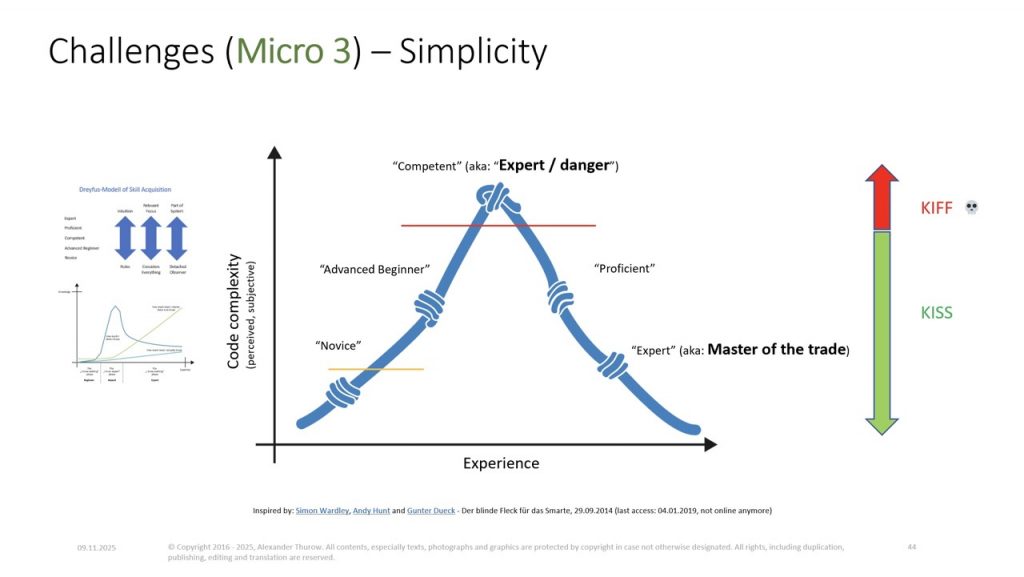
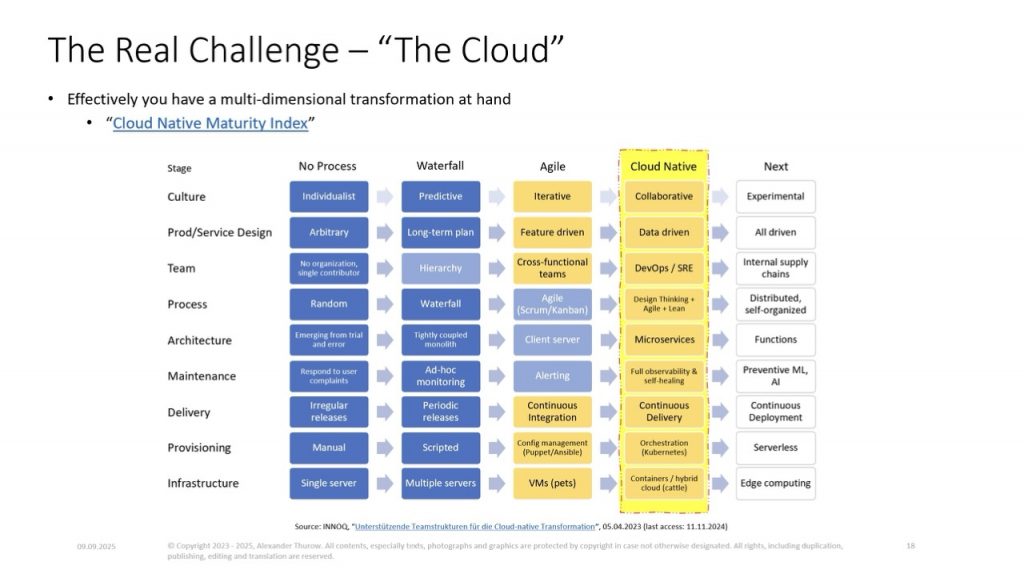
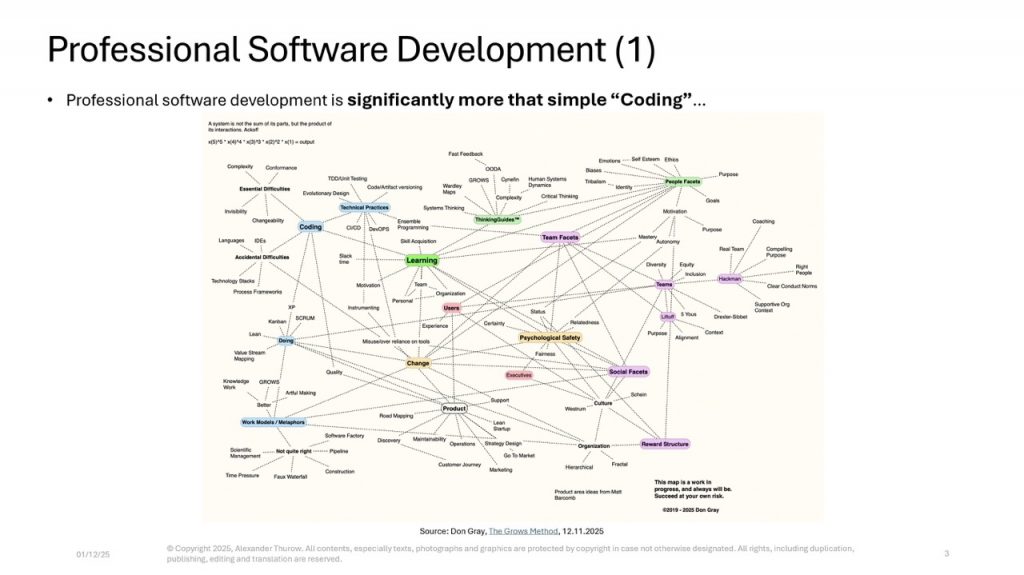
AKA:
The [underpinning structure] of all of your [current and future endeavors],
which is [continually being shaped] by your [collective actions] and [inactions].
10 seconds
… I am sorry. Today, I cannot help you in shaping your strategic professional software development ecosystem. I would be very happy to meet you soon at an upcoming „Thoughts on (Modern?) Software Development“ talk.
30 seconds
What I more and more realized during my 20-year journey through the field of professional software development1 is, that too many times the software development business, on its search for improved reliability and performance, is focusing too prominently on the first and integral part of the “(Modern?) Software Development” challenge2:
The technology itself.
Technology itself is a powerful distraction – especially if one or even more shiny new tools are involved. They have indeed been very seducingly leading us away from a path to more promising productivity gains which are much more likely to be found somewhere else:
In jelled teams.
Empowered teams.
Communicative teams.
Enabled by an environment of trust.
60 seconds
The Technology
Our ongoing search for increased productivity has put its focus too narrowly on one component of software development:
The technology itself.
Due to that fact technology sets out to become something that cannot be desired in the first place:
Technology becomes a powerful force of distraction.
Especially in the incarnation of the newest and maximally „shiny“ technology this undesired effect is observable again and again.
This way valuable cognitive resources of your development organization are squandered again and again.
The Team
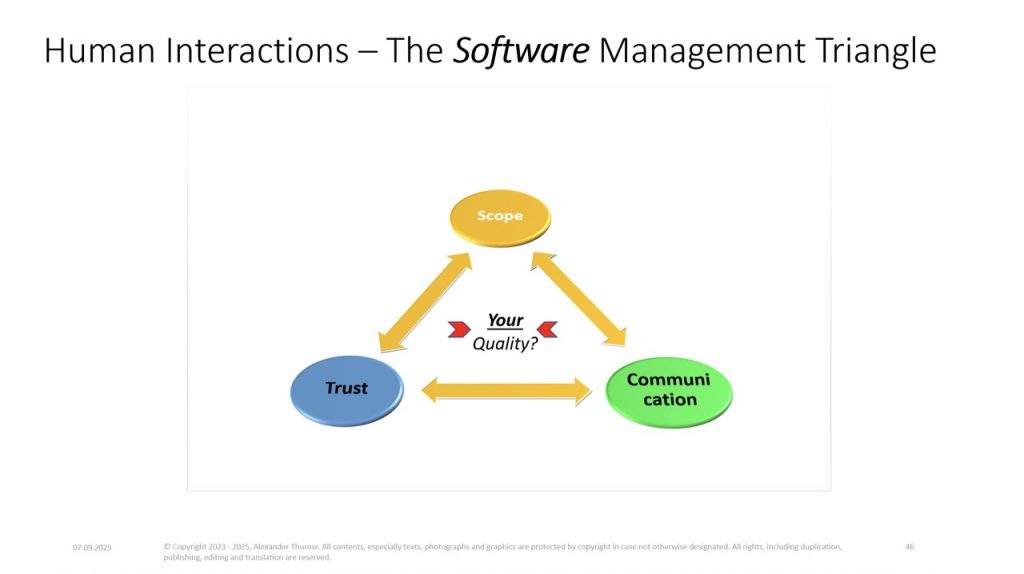
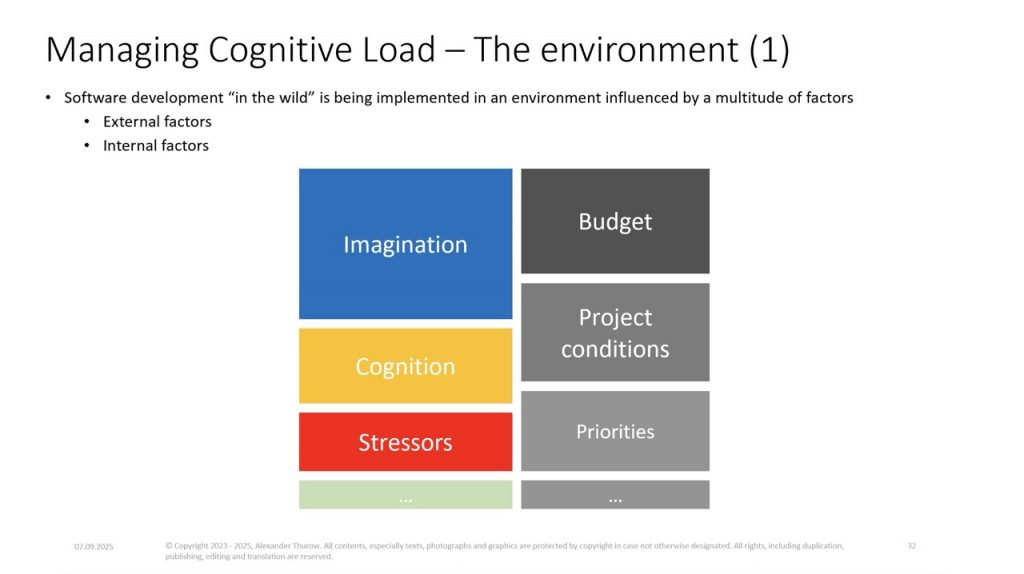
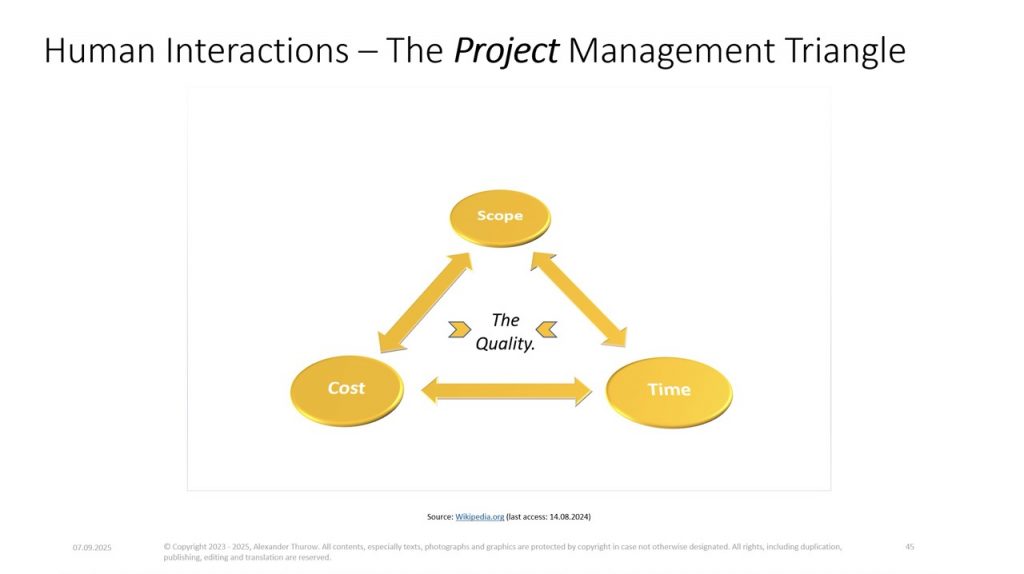
Software quality does not emerge the way the „classic“ Project Management Triangle did promise many decades ago: not in the tension field of scope, time and cost.
Instead quality in modern software development endeavors is being created when two of the components are being realigned:
Scope <-> Communication <-> Trust
Software quality is being produced where gelled teams are working self-dependent and have internalized that trustful communication is paying off.
The Individual
In order to empower your team to use the technology in a goal-oriented way, all involved individuals need to understand on which kind of „operating system“ we human beings are running on.
The decisive component and context for performing software development teams is the understanding of the interrelationships of:
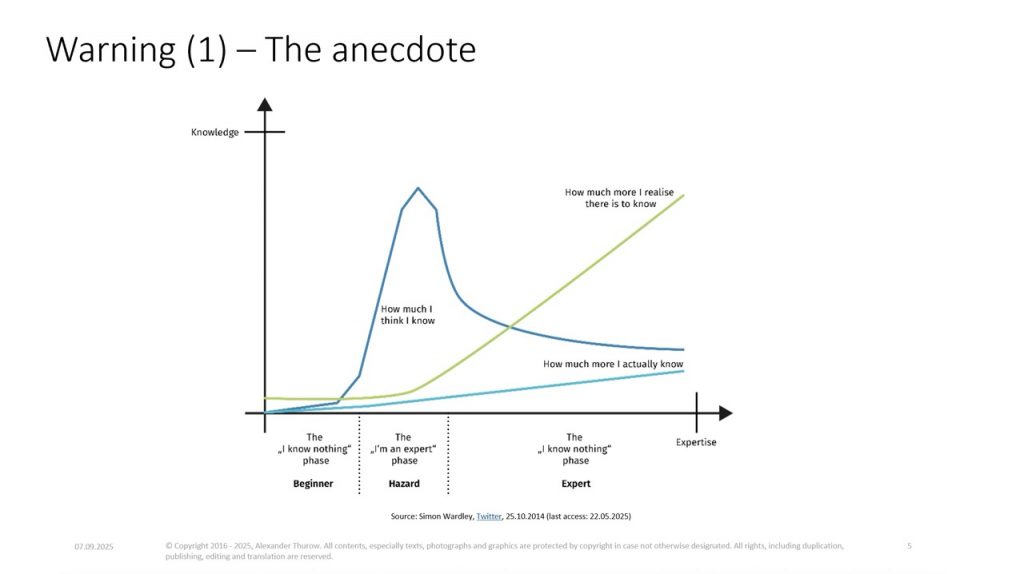
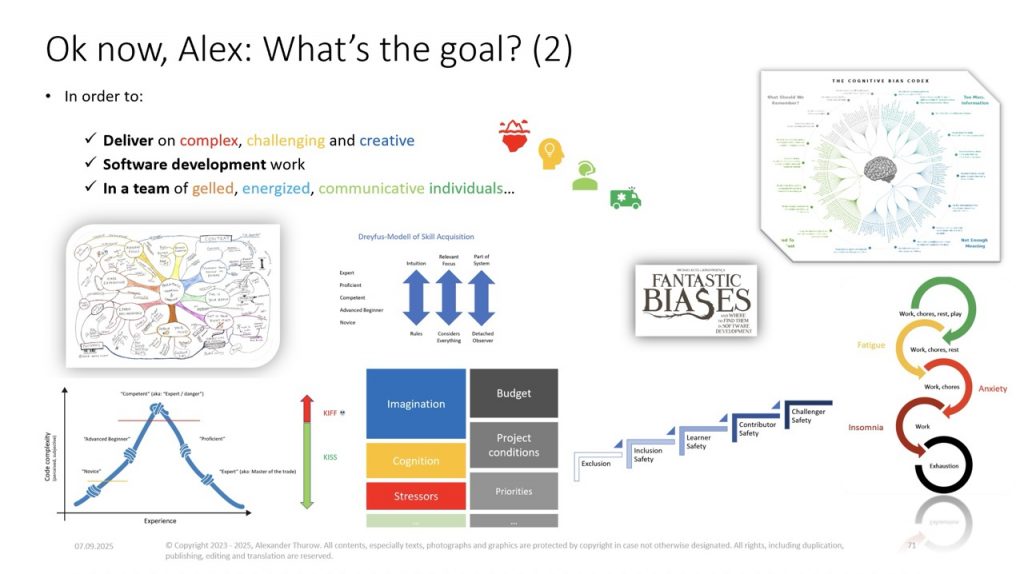
Imagination, cognition and stressors
The understanding of these „inner“ interdependencies most likely leads to improved innovation, creativity and performance in competitive marketplaces – aka: the „outer“ environment.
120 seconds
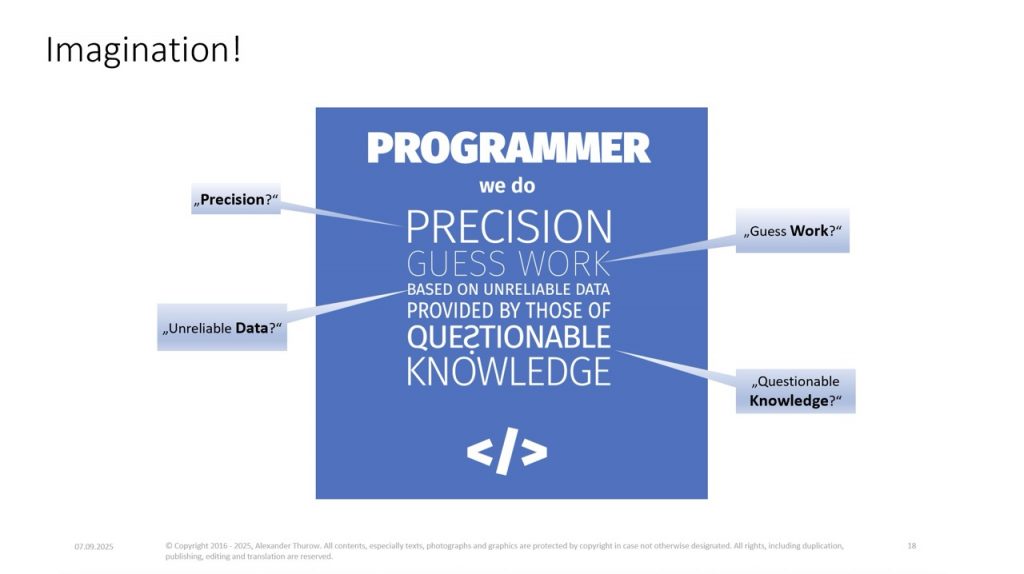
Have you ever been wondering in your busy day-to-day trenches of your professional software development or management career, why the beast you are trying to tame day in and day out seems to be such a stubborn, nasty and – alas – mighty creature?
Have you also been perceiving the following problematic – because reemerging – patterns in your daily development activities?
| An oftentimes unhealthy amount of „accidental complexity“, that drains on the cognition of your team. |
| A high amount of stressors – especially created by „shortcuts“ taken during the creation of the solution. |
| Shortcuts, that subsequently lead to „Technical Debt” (without a sufficiently highly prioritized continuous improvement process being implemented). |
| The result being „Technical Neglect” with its accompanying, self-feeding spiral of frustration. |
| Followed by a loss of motivation and/or team members or – worst of all due to the severe personal consequences – burnout. |
| Therefore team structures being shaken or torn apart. |
So far, so perceivable.
What I more and more realized during my 20-year journey through the field of professional software development is, that too many times the software development business, on its search for improved reliability and performance, is focusing too prominently on the first and integral part of the “(Modern?) Software Development” challenge:
The technology itself.
Technology itself is a powerful distraction – especially if one or even more shiny new tools are involved. They have indeed been very seducingly leading us away from a path to more promising productivity gains which are much more likely to be found somewhere else:
In jelled teams.
Empowered teams.
Communicative teams.
Enabled by an environment of trust.
The most promising approach leading to outstanding high-performance software delivery in the year of 2025 is, that we refocus our too strong a fixation on the technology part and sharpen our focus on all of the four constituent parts of the „(Modern?) Software Development“ equation:
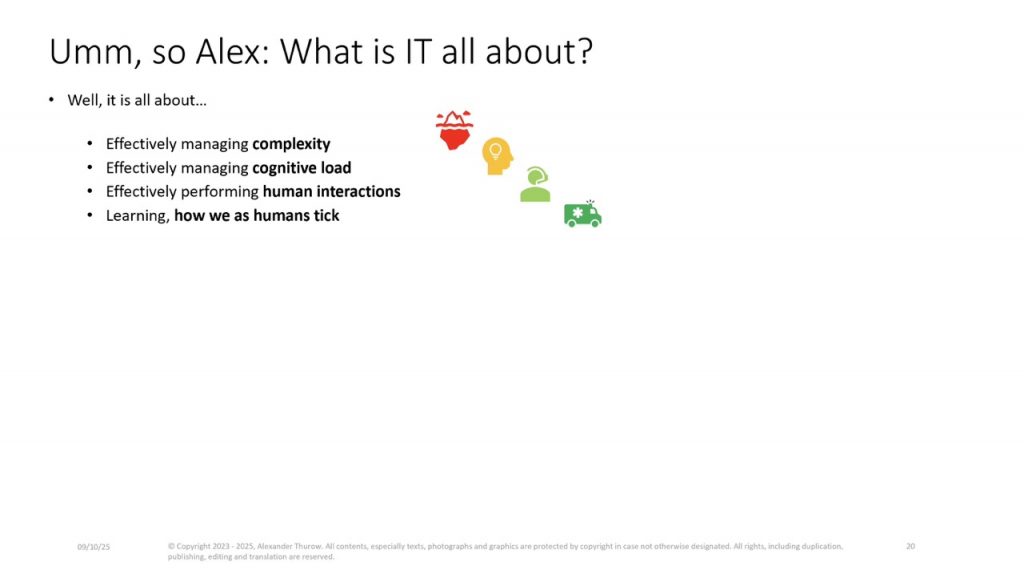
- Effectively managing complexity (“The Code”)
- Effectively managing cognitive load (“The Focus”)
- Effectively performing human interactions (“The Team”)
- Learning how we as humans tick (“The Individual”)
From my perspective this refocusing is becoming more urgent by the day because:
- Technology does not solve problems, people do.
- An underpinning environment of trust fosters communication.
- Effective communication and trust leads to improved morale and enable performance.
And improved performance leads to what modern organization need and are looking for on a daily basis: improved competitive advantage over other market participants.
So, consider breaking your possibly too strong focus on the technology and uncover a more balanced path leading towards high quality delivery:
The Code <-> The Focus <-> The Team <-> The Individual

600 seconds
Have you ever been wondering in your busy day-to-day trenches of your professional software development or management career, why the beast you are trying to tame day in and day out seems to be such a stubborn, nasty and – alas – mighty creature?
In my career I started to wonder quite early whether I might have possibly missed something crucial during my formal education and/or my initial years in the business. Something that might have explained the perceived mismatch between theory and lived practice, the mismatch between the expectation of smooth high-tech business value delivery – accompanied by the mythical “in time, in budget, in scope” – and the real-life realization of an ongoing, energy-draining struggle towards – rightfully expected – quality delivery.
After a few years in the business and striving painstakingly towards those “real deal” quality results, I realized: “No Alex, you have not been missing some (or even ‘the’) crucial parts of the picture.” Effectively I realized at that point in time, that quite likely almost everyone in the software development business is struggling with the same challenges – only perceived in different shades and on different scales:
- Unhealthy levels of „accidental complexity” eating at the teams’ cognition, on top of the non-reducible „essential complexity” of the to-be-created software.
- A multitude of stressors producing further runaway accidental complexity – especially by pressure-induced „shortcuts” being taken time and again while creating the solution.
- Those shortcuts leading to „Technical Debt”; which is oftentimes not being addressed due to a too low-prioritized continuous improvement process.
- The direct result being „Technical Neglect” – which poses a significant risk of a frustration spiral setting in.
- Which might ultimately lead to employee churn or – worst of all due to the severe personal consequences – burnout and therefore…
- … emerging or existing team structures being shaken or torn apart due to an additional multitude of external or internal factors.
So far, so perceivable.
With more experience, continuous research and learning “out there in the wild”, it slowly began to dawn on me that too many times the software development business, on its search for improved reliability and performance, is focusing too much on the first and integral part of the “(Modern?) Software Development” challenge:
The technology itself.
Technology itself is a powerful distraction – especially if one or even more shiny new tools are involved. They have indeed been very seducingly leading us away from a path to more promising productivity gains which are much more likely to be found somewhere else:
In jelled teams.
Empowered teams.
Communicative teams.
Enabled by an environment of trust.
The most promising approach leading to high-performance software delivery in the year of 2025 is that we refocus our too strong fixation on the technology part of the software development equation and sharpen our focus on all of the four constituent „(Modern?) Software Development“ factors:
- Effectively managing complexity (“The Code”)
- Effectively managing cognitive load (“The Focus”)
- Effectively performing human interactions (“The Team”)
- Learning how we as humans tick (“The Individual”)
From my perspective this refocusing is becoming more urgent by the day because:
- Technology does not solve problems, people do.
- An underpinning environment of trust fosters communication.
- Effective communication and trust leads to improved morale and enable performance.
And performance leads to what modern organization need and are looking for on a daily basis: improved competitive advantage over other market participants.
The negation of the equation on the other hand oftentimes reads like this:
- Problematic selection of “shiny new” software technology and undisciplined, stress-impacted software development create the “Technical Debt/Technical Neglect” spiral.
- The “Technical Debt/Technical Neglect” spiral subsequently further increases stress.
- Accruing stress has an increasingly negative impact on cognition, imagination and creativity.
And if you allow these dynamics to settle into your development organization you start to progress on a dangerous path.
When you are risking to lose cognition, imagination and creativity on the level of the human individual, you incrementally lose major assets of your development organization. When you, in the wake of this development, lose trust, you next lose communication. Having lost your communication channel, you will be going blind related to your “real” progress, your “reality on the ground”.
When these threatening dynamics set in, you will over time quite likely lose your most valuable asset: Your team. Much worse if it used to be a jelled team. If you lose that, you will have lost a lot: You then lost your most likely shot at competitive advantage over your competitors.
And it needs to be said here and now and in exactly this context: Your individual high performers with massive reservoirs of cognitive capabilities are:
- only an exception to the rule and
- are too not immune to increasing levels of stress.
(Additionally: You should never forget the old adage that “Rockstars and ninjas lead to broken furniture and dead bodies”. You do not want this… really, really – not :/)
Instead, some healthy dose of boring software might empower you and your team to focus on the business value that you want to ship to your customers. Subsequently, it might at last enable you to deliver maintainable, reliable “real deal” quality software to your customers.
So, consider breaking your possibly too strong focus on the technology and uncover a more balanced path leading towards high quality delivery:
The Code <-> The Focus <-> The Team <-> The Individual
If you and your organization are in need for, or plainly interested in, further details about the approach I outlined, you can find my service offering at:
Live long and prosper 🖖,
Alex